The Siege of Shaddis Horne and the Tale of a Lost Dog
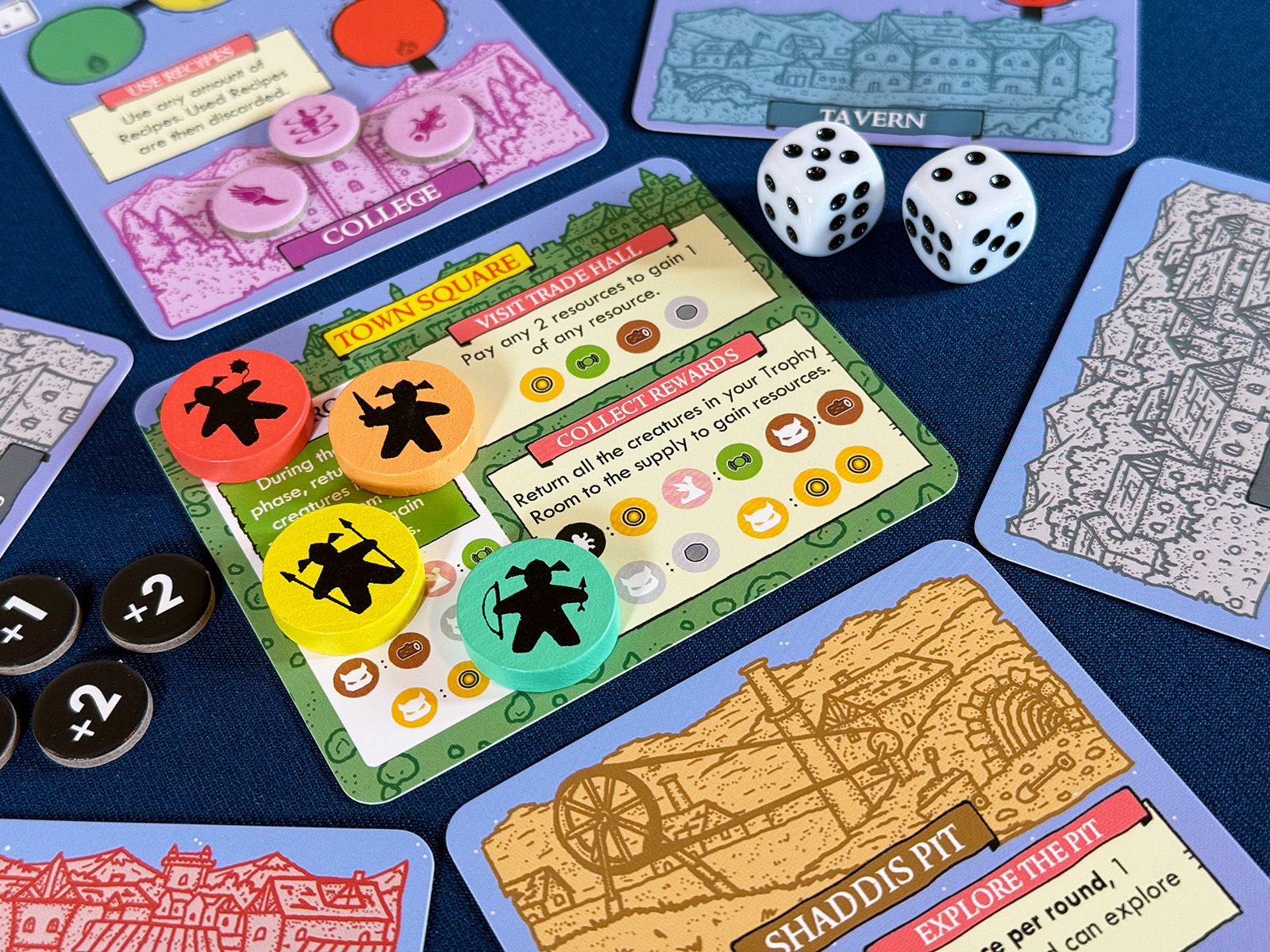
Protect a town from faeries and other creatures with a clever use of villagers and soldiers in The Siege of Shaddis Horne.
Some of my fondest memories are in the world occupied by Paupers’ Ladder, and I was excited to try out a new tin game. The Siege of Shaddis Horne is akin to a tower defense solo game with locations to protect and enemies to slow down. With an understanding of the rules and my role as protector, I set out to carefully plan the best ways to survive until the end!
Game Overview
Game Name: The Siege of Shaddis Horne
Publication Year: 2026
Designer: Paul Stapleton
Artist: Paul Stapleton
Publisher: Bedsit Games
Solo Mode: Designed for Solo (Included in the Base Game)
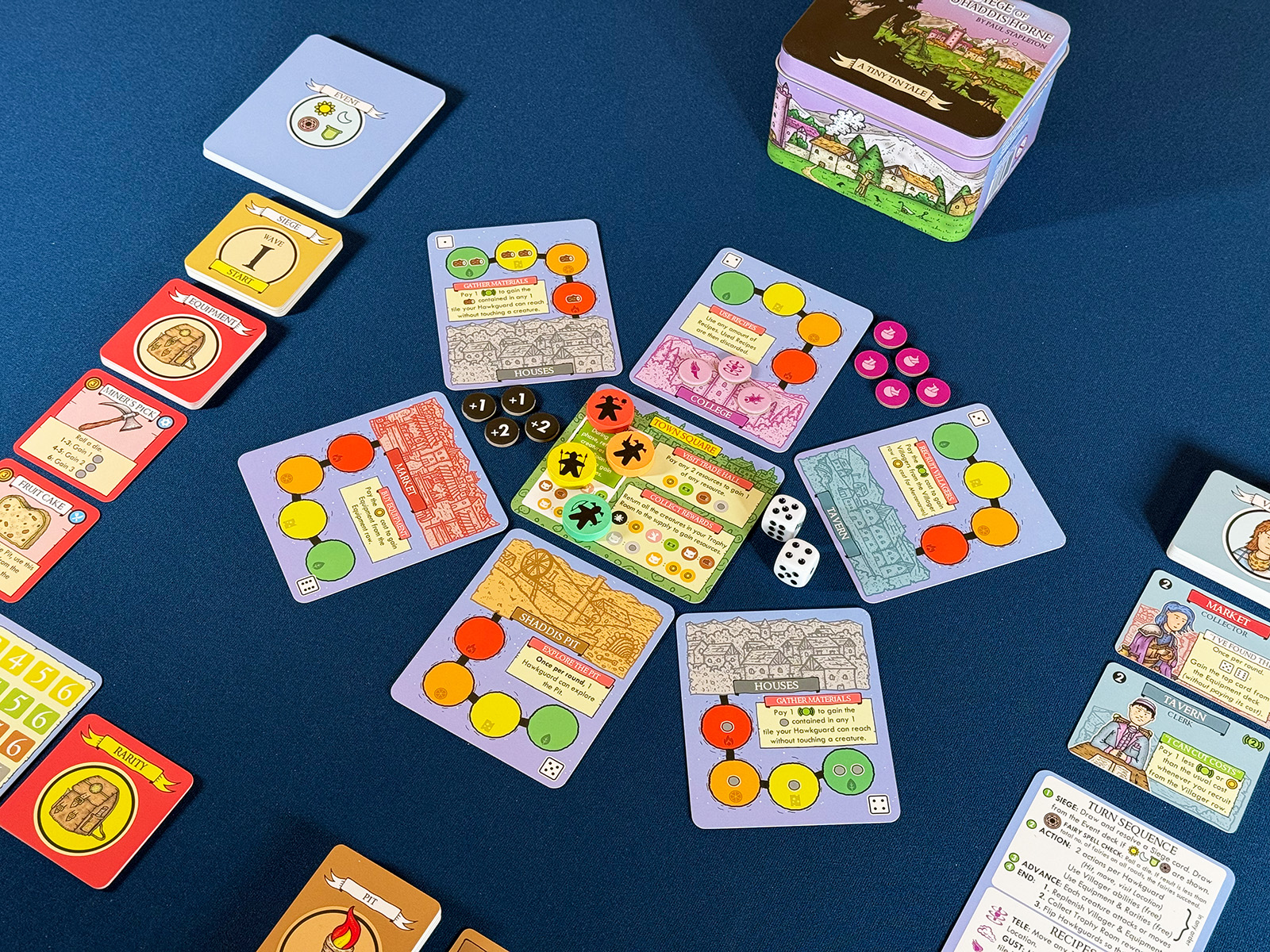
Over the course of 4 waves, creatures like faeries and golems arrive along the roads. Locations must be protected by the various soldiers, as well as recruited villagers. There are resources to gather and even an interesting pit to explore for stories and rewards! Withstanding the siege is a challenge.
First Play
September 20, 2026
Complexity
3
Latest Play
September 21, 2026
Expansions
0
Setup Time
10 Minutes
Lifetime Plays
2
Play Time
1 Hour & 15 Minutes
High Score
70
Game Area
26" x 18"
Low Score
63
At the Town Square
The core set of actions center around the 4 soldiers. Each is color-coded to a specific space on each road. That’s where their attacks are able to thwart the faerie advance!
Actions involve moving about and attacking, along with making use of the locations. There are resources to gather, spells to cast, items to purchase, and a pit to explore.
Lots to enjoy! I loved how much content seemed to be in a relatively small box, and the variety seemed pretty great.
I didn’t expect to win right away, but I had some plans in mind from the flip of the first card. For Shaddis Horne!
Into the Pit
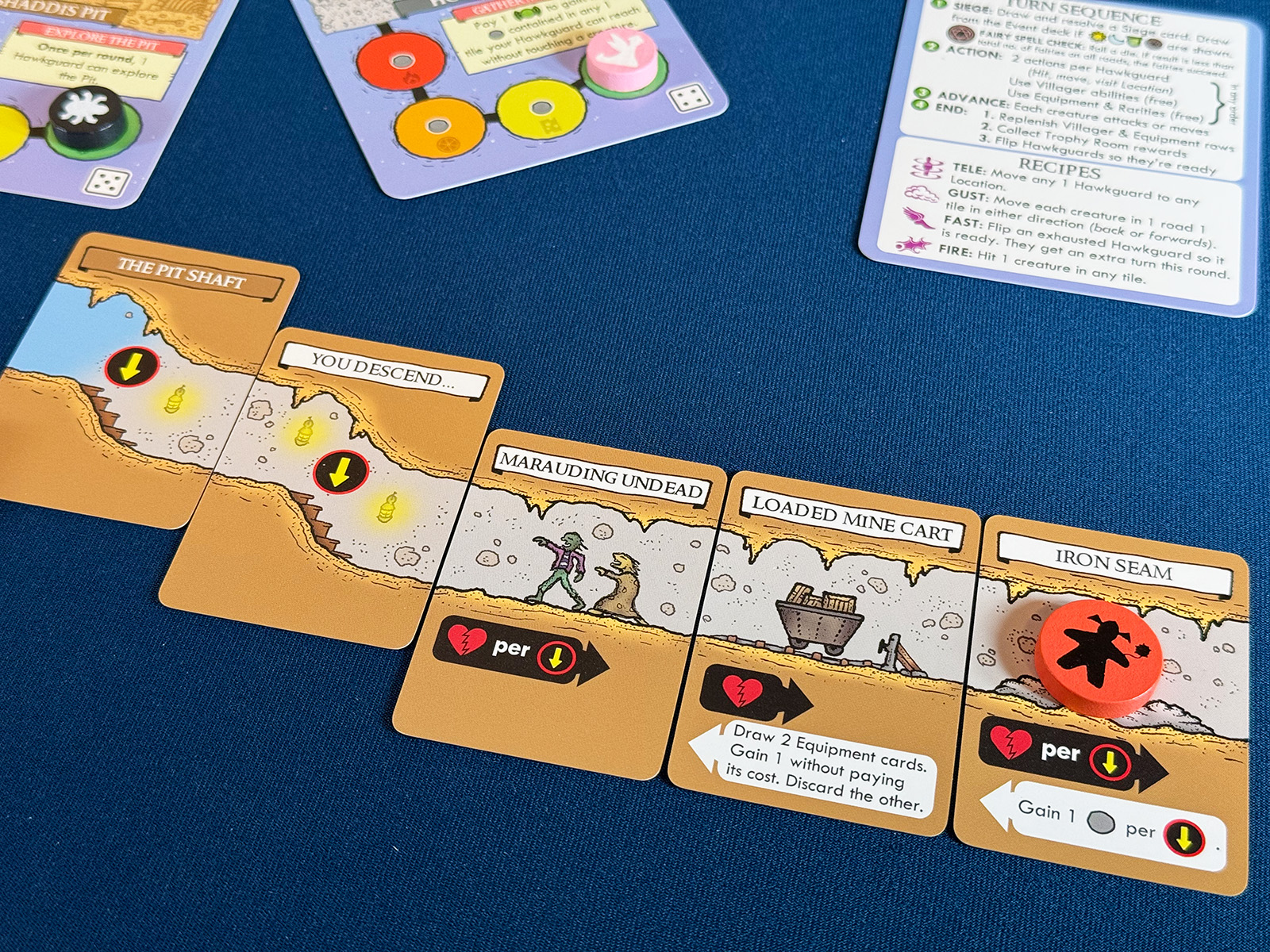
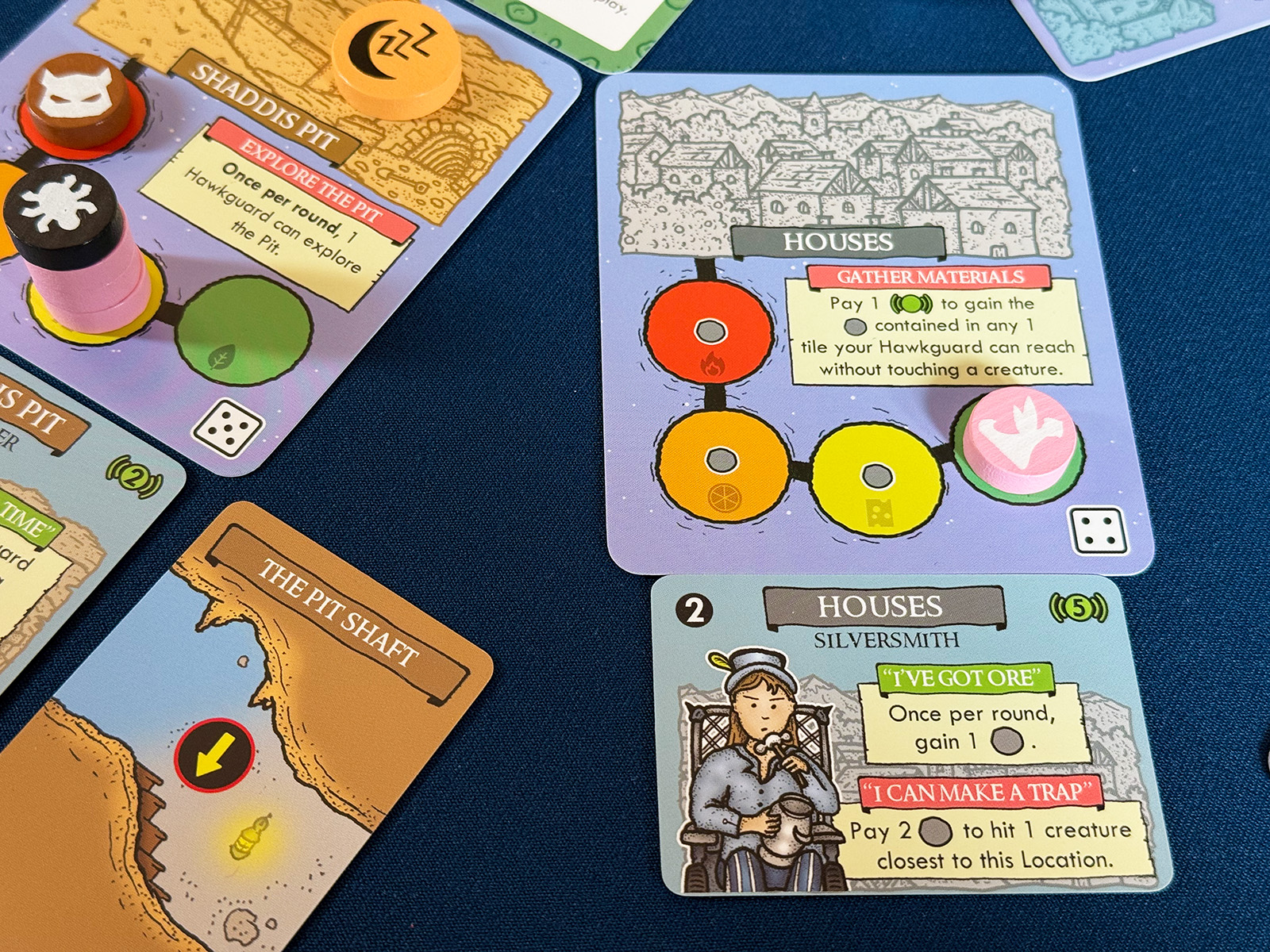
Probably my favorite part of this adventure were the stories that came from the pit. This is an action a single soldier may undertake once per round to find what lurks underground…
It was great! There was an element of pushing my luck with the number of wounds and rewards, plus all the stories.
The first descent was deep underground and featured an attack from the shambling undead, the discovery of a filled mine cart, and a valuable iron seam. Such a great time!
However, the deck is not reshuffled and I ended up seeing all of the cards pretty early on during both of my plays.
Events Galore
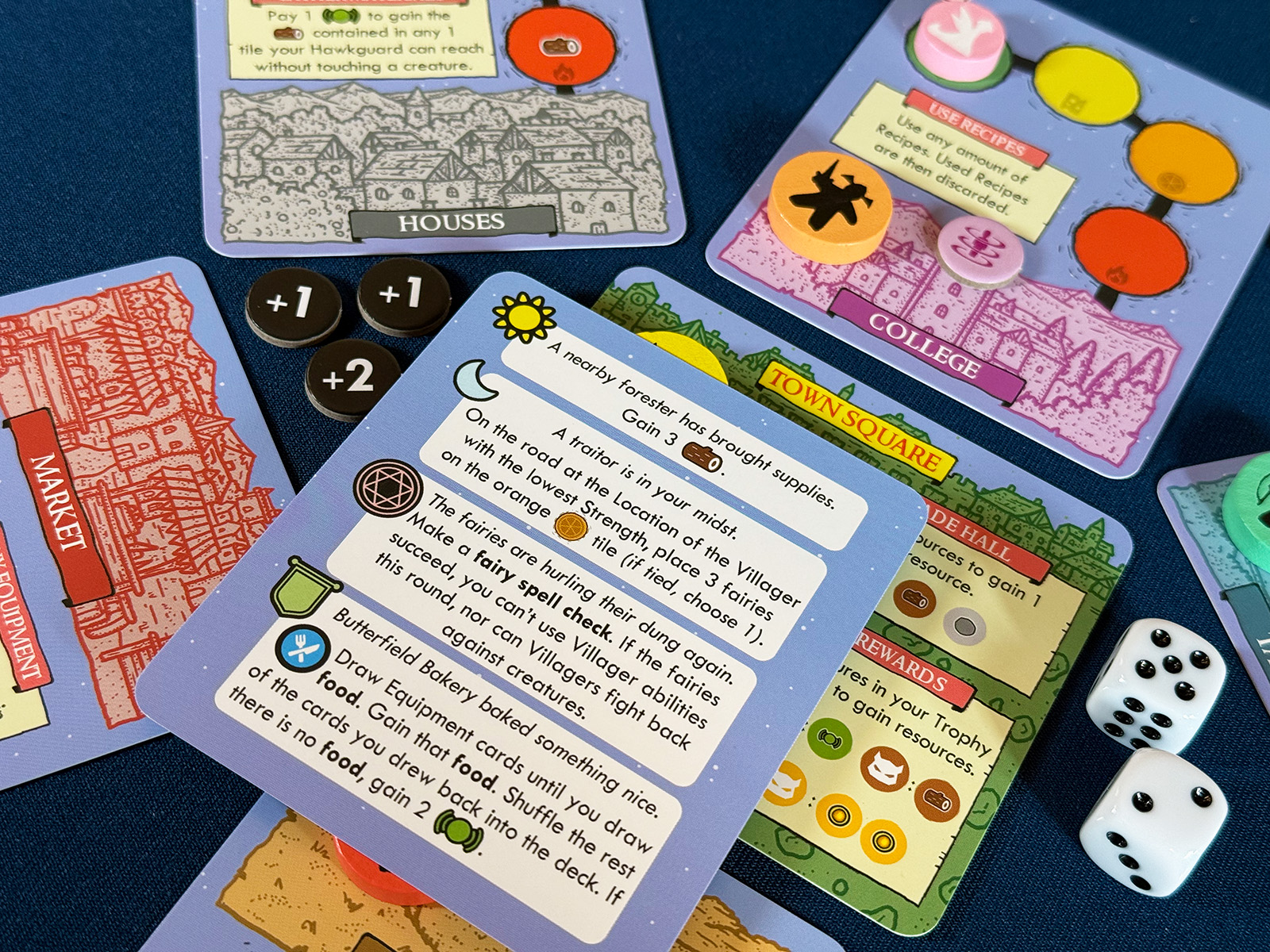
A siege card adds new enemies each round, along with some sort of event. Event cards offer a different effect, adding a lot of variety. Those moon and spell spaces were no joke!
Early rounds were a little lackluster, owing to a lack of gold and influence. I couldn’t take most of the location actions, and simply focused on placing the soldiers in good spots.
My interest was pretty high initially, though, as it felt like everything started to pick up speed around the third wave.
Yet I couldn’t help but feel like gameplay was taking much longer than I expected. It had already been over an hour.
The Story of a Lost Dog
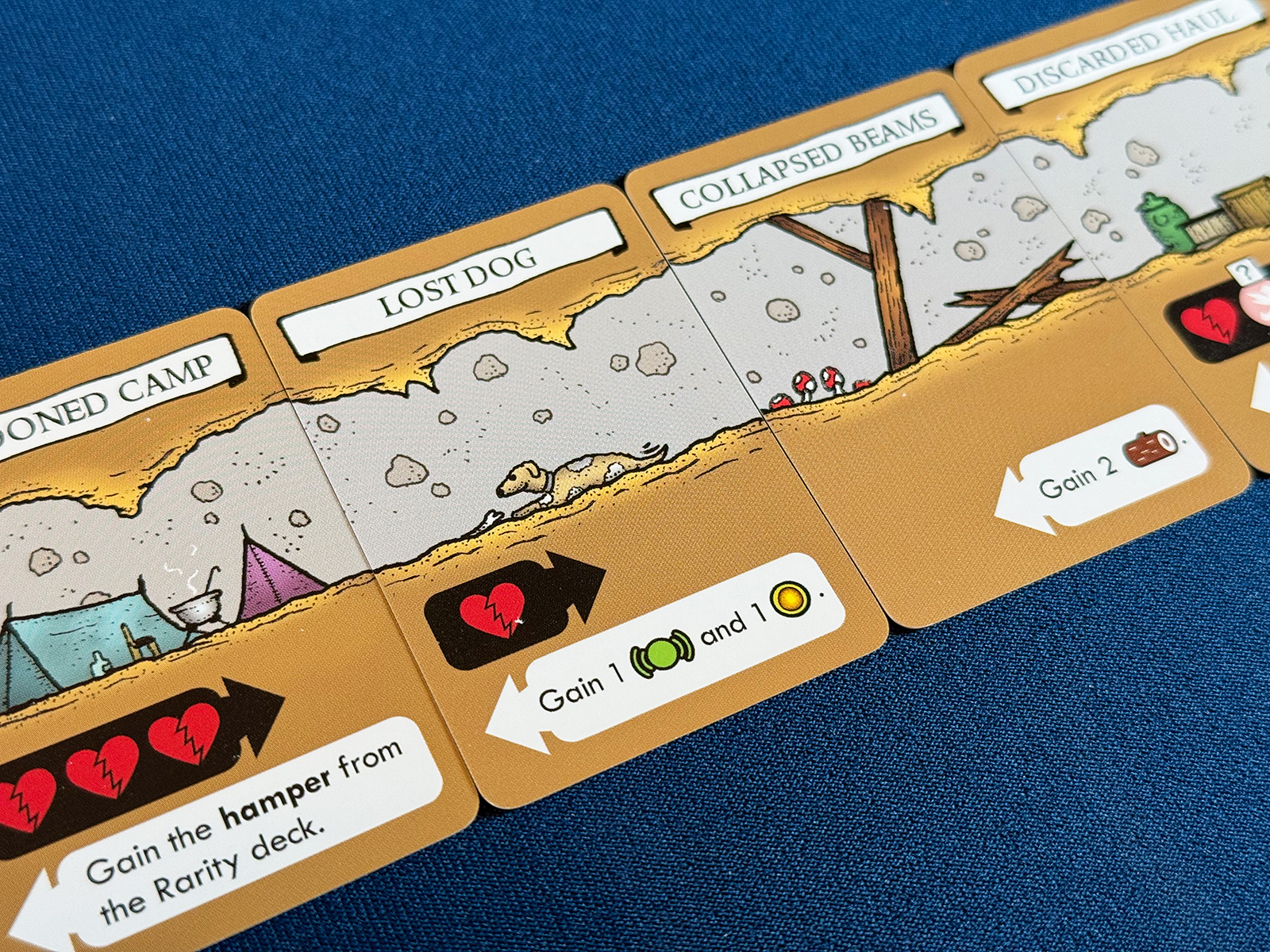
Before I realized that the mine cards were single use and always seen, I labeled the pit as the best part of the game! So it was no surprise when I had no reason to explore later on.
This journey was full of abandoned and decaying areas, yet the highlight was the discovery of the lost dog. Look at that wagging tail! Definitely a delightful card to flip over.
Exploring the pit may only happen once per round, not per soldier, which helped me space out the journeys slightly.
All the same, it was very luck-based and seemed like an obvious way to gain resources and items early on.
Bridging a Setting and New Set of Mechanics
There are a few tower defense or threat management games in my collection. I wouldn’t say I dislike the genre, although I tend to prefer others. Picking this one up came down to my love of the setting, but it can be a challenge to bridge that gap. Many features seem to be pretty great, and if I was only expecting to play it twice, I likely would have been very happy!
Yet I kept thinking of how the little stories I created would be better suited to the widely varied adventures I’ve encountered in Paupers’ Ladder. Maybe the lesson for myself is that I simply enjoy the original, and don’t need to chase after anything else… I’ve already got an excellent game set in Brighthelm that I love! Still, I had some fun with this one. I found a lost dog!
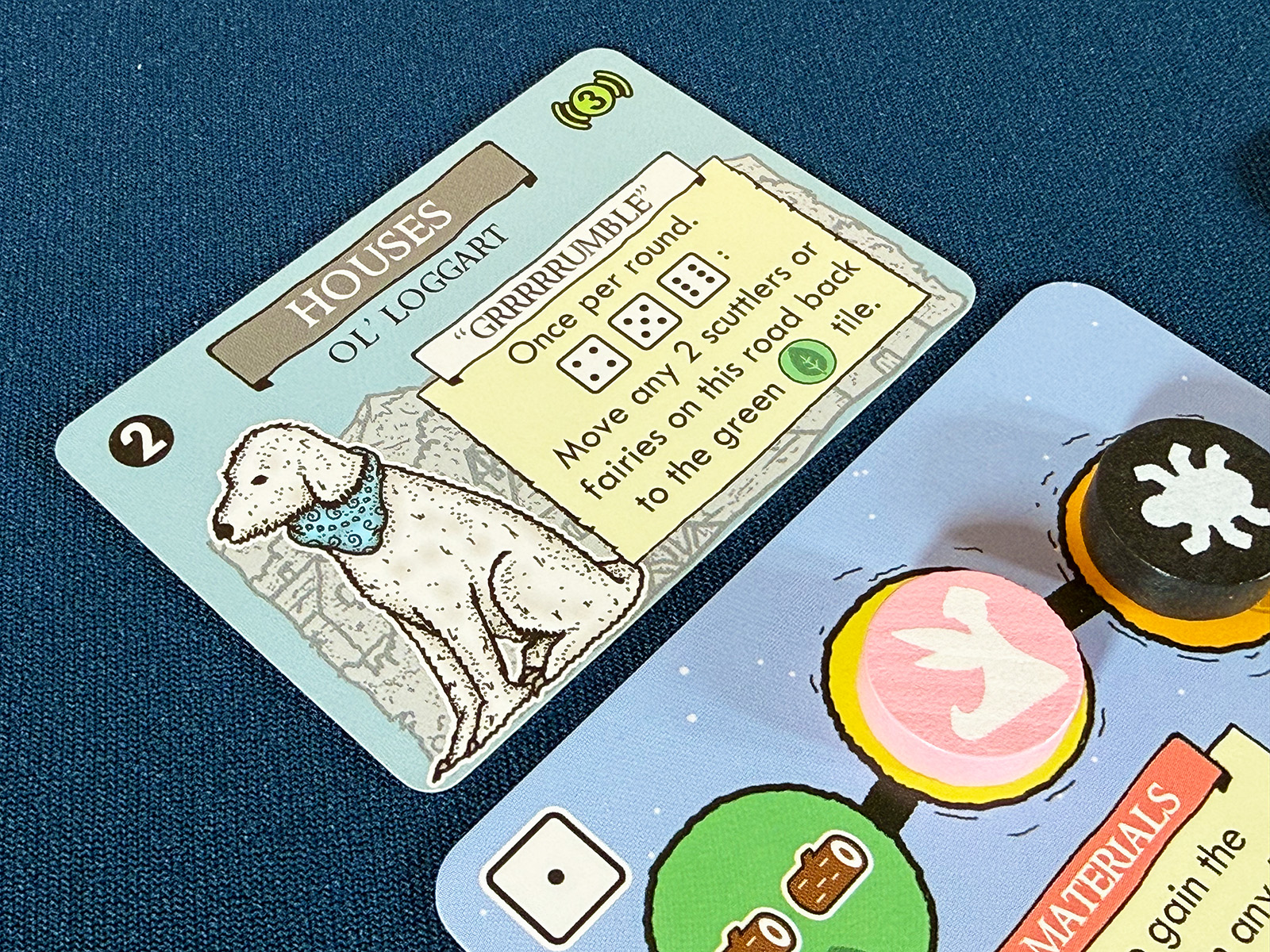
It’s Ol’ Loggart!
Owing to my joy in coincidences and stories, I was most pleased when I had the chance to flip over and recruit a villager at no cost. Who was it? This adorable dog, of course!
You can’t tell me that’s not the lost dog I rescued. Ha ha! Ol’ Loggart was amazingly helpful at guarding the houses.
I was able to roll a die once each round, and with a 4, 5, or 6, he grumbled away to scare lower level enemies back to the starting road space. Most useful with the green soldier!
Alas, I was saddened when the siege became intense and Ol’ Loggart fell during an attack by a golem. Not the dog! No!
Overrun by Faeries
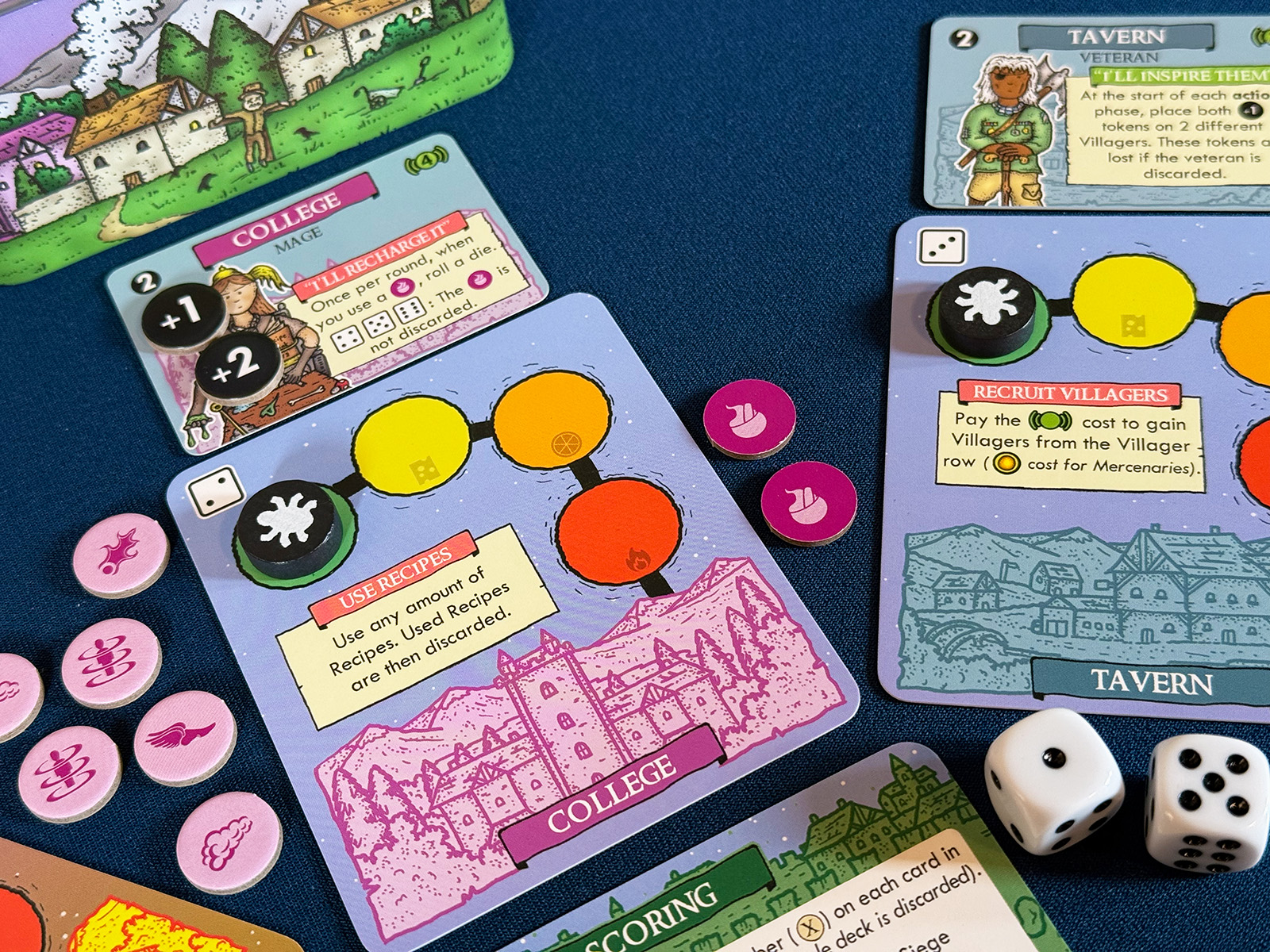
Oh, dear! I thought I was doing quite well, until I wasn’t. Some of the later wave siege cards added a lot of enemies, or resulted in events that triggered twice. Poor Shaddis Horne!
A location can be destroyed once, yet as soon as an enemy reaches it again, that marks the end as an immediate loss.
I liked parts of this one, and definitely felt like it had the charm of the setting. The villagers in particular were great: They added personality to every location in a fun way!
It wasn’t too hard to set everything up for a second play, but I was a bit concerned that I had already seen everything.
A Powerful Mage
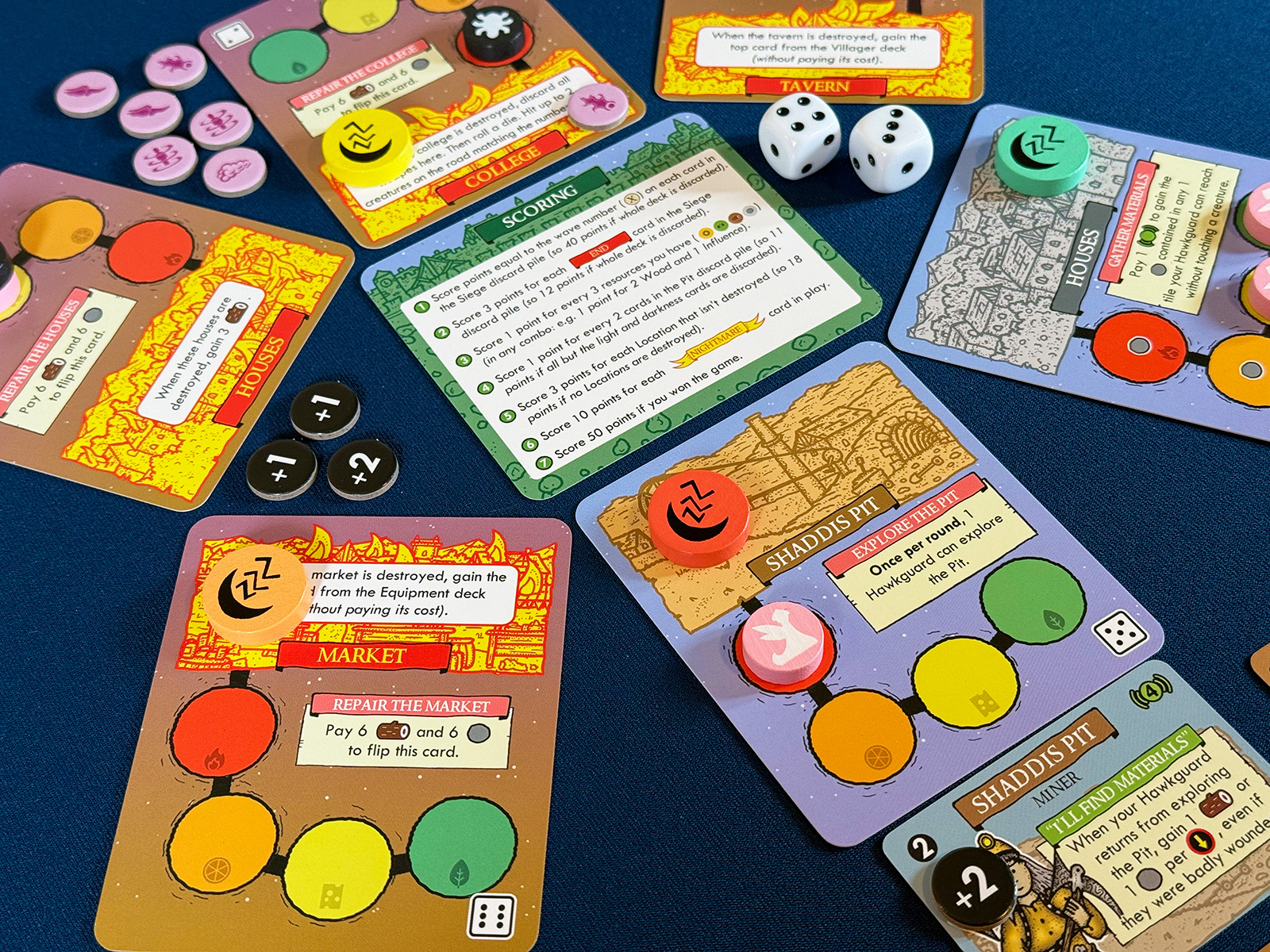
This time, I recruited a veteran at the tavern very early on. He helped inspire other villagers, thereby increasing their defense value. And I had a legendary item ready to use…
Effectively, the mage stationed at the college found herself in a powerful position! I didn’t make the best use of her, but she could easily thwart the scuttlers and faeries.
I liked the different abilities of the villagers, but gameplay felt pretty similar and very lengthy for what it offered.
The pit resulted in the same cards, although I didn’t pair the lost dog with Ol’ Loggart this time. A rare and perfect story!
Silversmith Traps
In desperation near the end, I spent all the iron ore I could on traps designed by the silversmith. This worked out very well in defending surrounding locations… Until it didn’t.
There were some very neat moments. I liked the rising tension and the choices I had to make. Although I didn’t win, that felt like the only thing I didn’t achieve.
Some aspects have plenty of variety, but not all of them. I’m sure there are other neat villager actions I didn’t see.
I wanted to love this one, yet it didn’t quite work out for me. Maybe that’s for the best… I am one terrible town protector!
Session Overview
Play Number: 1 & 2
Solo Mode: Designed for Solo (Included in the Base Game)
Outcome: 63, 70 (2 Losses)
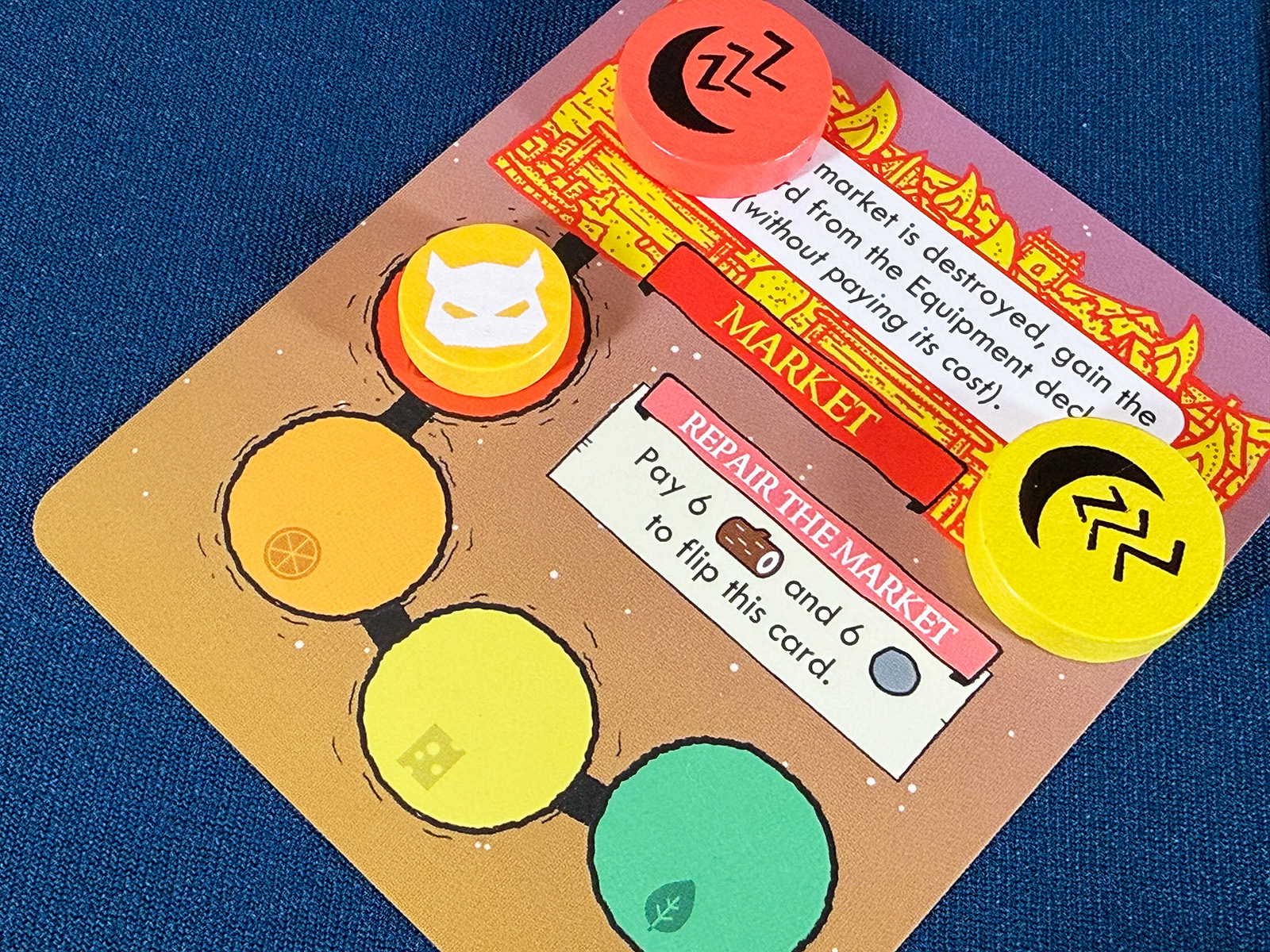
It was the market that fell during both plays. Not sure what that says about me… Except that I am inept with tower defense. Ha! As I mentioned, there were a lot of elements that were interesting and my first play offered a great deal of fun. I’ll never forget Ol’ Loggart! Alas, with a rather lengthy play time and some features that felt a little too static, I’ll be moving this one along. For fans of the tower defense genre, though, there’s a lot of game in this tiny tin!
%
1 Play
Affordability
Price & Value
7
Functionality
Challenges & Mechanics
9
Originality
Design & Theme
7
Quality
Components & Rules
9
Reusability
Achievement & Enjoyment
5
Variability
Distinctness & Randomness
4
+ Pros (Positives)
- The artwork is charming with little scenes and memorable characters to add plenty of personality to the town.
- Following the round sequence is easy with a helpful summary card that distills the rulebook down to a short list.
- Gameplay is very interesting and full of surprises during the first few plays, especially with the pit card discoveries.
- Tension slowly rises from the early waves, which are easy, to the final wave, which requires carefully planned actions.
- Soldiers often move, but their second action offers some neat decisions between attacking and using locations.
- A lot of game elements are contained in a fairly compact play space that’s easy to reach and understand from afar.
– Cons (Negatives)
- Play time feels like it drags on quite a bit, and reaching a victory can take upwards of 1-2 hours, even at a fast pace.
- All of the pit cards are seen during a play, and scoring encourages emptying the deck, which limits the variety.
- The amount of overhead isn’t terrible, yet it becomes noticeable when there are multiple villager abilities to track.
- Cards on offer, like at the market and tavern, can get stuck without any good options and no way to refresh them.
Victory Conditions
Win the Game
- Overall Goal Progress 0%
Goals and Milestones
Score at least 100 points.
Win at least 1 game.
Continue the Conversation
Have you had a chance to play The Siege of Shaddis Horne? Is there any memorable card or villager combination that stood out for you? I appreciate what the game offers, and certainly enjoyed it in some respects! Although it’s often easy to make space for small boxes, my shelves are still quite crowded and I’m sure my copy will find a better home soon enough.
0 Comments