Solving a Suspects Mystery with the Power of Obsidian

Track down important leads to solve a thrilling mystery and find the right conclusions with the fewest clues in Suspects.
It’s no surprise that I love mystery games, and often try out whatever I can! There are never enough mysteries… And that’s coming from someone who will rewatch mysteries I know the solutions to. Ha! Suspects: The MacGuffin Affair was a random addition from GenCon 2022, and I couldn’t believe I hadn’t used my sleuthing skills until now!
Spoiler Alert
As far as I remember, this is a free introductory case to showcase the system. It’s not as readily available as the rest of the series, but be aware that there are some spoilers here. In particular, the couple of images of my digital notes contain far too much information if you look closely. Skip by all the photos if you’d like to keep all parts of the case a surprise!
Game Overview
Game Name: Suspects: The MacGuffin Affair
Publication Year: 2021
Designers: S. D. Nedellec, P. Halter, and G. Montiage
Artist: Émile Denis
Publisher: Studio H
Solo Mode: Included in the Base Game
This introductory case uses a set of cards to slowly reveal information. Choosing the order to explore is vital, as more victory points may be earned by reaching the answers early. However, the goal is to sift through all the clues and solve the mystery surrounding Mr. MacGuffin!

First Play
May 13, 2023
Complexity
1
Latest Play
May 14, 2023
Expansions
0
Setup Time
Almost None
Lifetime Plays
2
Play Time
1 Hour & 30 Minutes
High Score
9
Game Area
18" x 20"
Low Score
9
Meet Claire Harper
The case takes place in the 1930s and stars an up-and-coming sleuth named Claire Harper… The best detective!
I didn’t know anything about this system, other than the fact that it involves victory points. This can sometimes be counter-intuitive to solving a mystery. Follow every lead!
Fortunately, it uses a clever system that awards more victory points simply by getting answers correct with fewer cards. Guesses may be updated at any point.
It’s easy to score well by making deductions after seeing all of the cards, though it’s nice to be right early on!
Just a Deck of Cards?
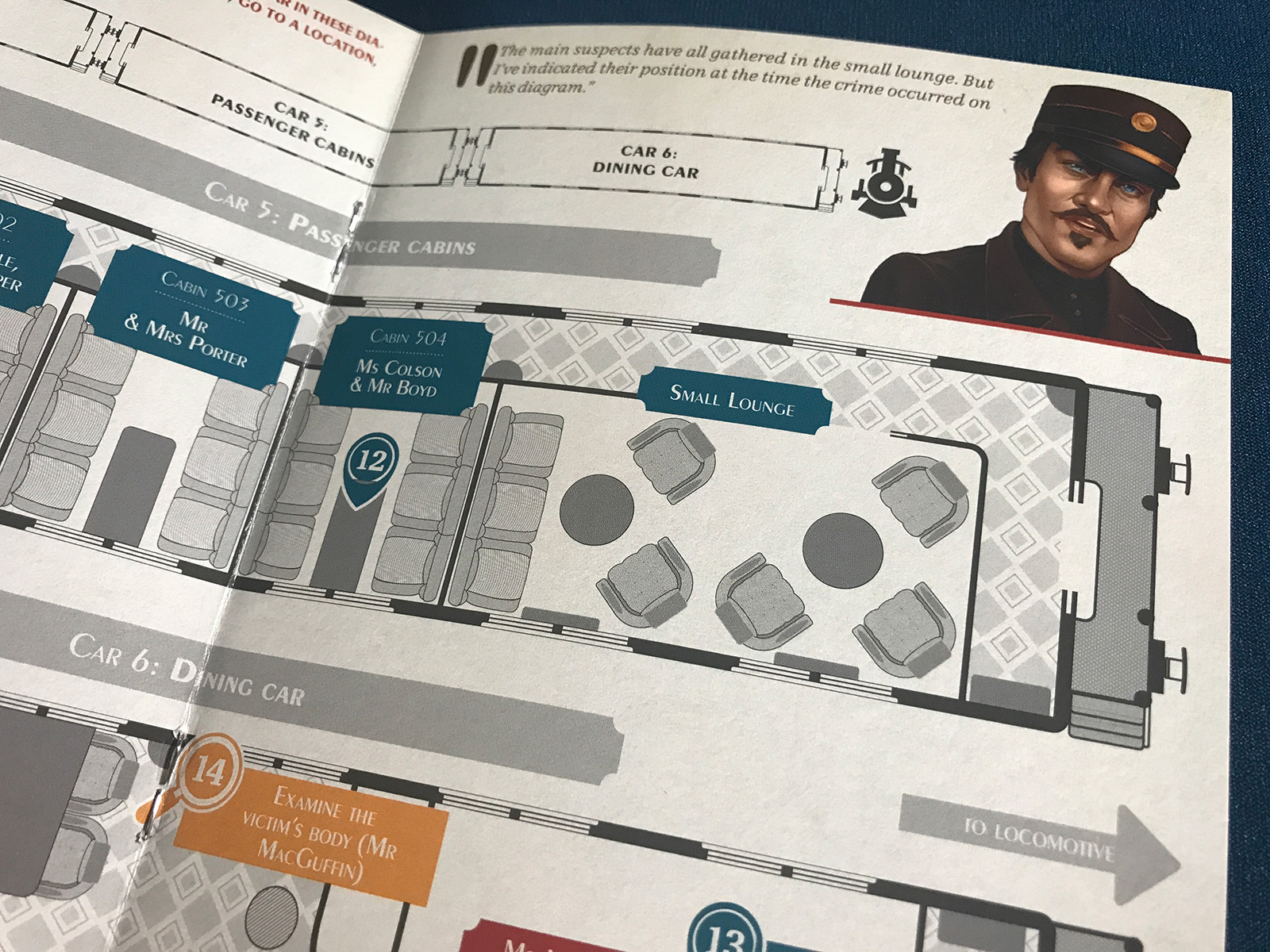
These large format cards create almost the entire experience. Aside from a small booklet with rules, a case introduction, and a diagram, this is where the action is!
32 cards represent this case, and that number appears to be larger with the full cases. Not bad for an introduction, though. This is all about figuring out the clue paths.
The numbered cards aren’t read in order. Each one is chosen based on clues from previous cards or diagrams.
And there aren’t any spoilers since the card backs just provide a sense of the card without any details. Awesome!

Going to Obsidian
Recently, I stumbled across the free note-taking software, Obsidian. It looks barebones on the surface, but I found some excellent tutorials to use it for solo roleplaying!
While working on my notes for a tabletop RPG, it dawned on me that I could probably use this for my notes.
It is fantastic! There is a simple markdown language to learn, but shown here is the best feature: Linked notes. By hovering over the name John Harper, his note appears.
I hid the note names on the left to avoid spoilers. Just brace yourself for what else I did for this case!

Learning a New Digital Program for Games
I completely respect and understand those who don’t want to use any sort of digital device when playing solo games. That’s usually where I land, too, and use app-assisted games very rarely. But with my oddly perfect handwriting, it takes me ages to fill in a page, and I’ll often flip all over the place to remember what I was trying to deduce.
Obsidian is a very simple sort of program that does well with all sorts of custom plugins. It’s primarily a way for me to get back into solo RPGs, as my notes for those never follow a proper track! I can type much faster, and the ability to do some many powerful things with just some text and images is something I’ve wanted to do for ages.
Learning a new program can take some time, yet I managed to put it together in a couple of evenings by watching some excellent tutorials designed for tracking and running tabletop RPGs. I know markdown language, have a great structure in place, and can even run some simple queries to pull information from multiple notes. It’s very neat!
Where to begin? You need a single link: The Complete Noob Guide To Obsidian.md for Dungeon Masters. That’s it! Follow the video tutorials listed in order, and search for any other specifics if you want to learn more.
I’m far from an expert, yet if you’re looking to do anything similar to what I have here, ask away! This took a little time to set up, yet I flew through this investigation in a way I rarely do with mysteries. Organized notes can make a huge difference for solo RPGs or games. The best part is that I only had to invest some time to learn everything here. Fun!
Useful Card Backs
As I chose my way through the beginning of the case, I had the opportunity to decide which cards to look at first.
These really aren’t spoilers, either: Just the card backs to show my initial path. Sifting through the deck doesn’t reveal anything, which is quite clever.
It was a real mystery, and I didn’t know what to do. Yet I started to follow each lead and discovered more and more about the case through clues, locations, and people.
The best part is probably the fact that nothing is obvious. Deductions must be made based on multiple card details.

Looking for Clues
This is simply the back of the very first card that may be flipped over, so it’s not a true spoiler. People often provide dialogue, yet there might be other details to discover.
At the bottom of this one, new card options opened up if I wanted to question the train manager some more.
Like I said before, higher scores are possible by getting the right answers after seeing a small number of cards.
But it wasn’t like I was going to skip out on seeing cards: All of them should be looked at, yet writing down guesses at the right times is important to try to unravel the clues.

A Pepe Silvia Situation
If you’ve ever watched It’s Always Sunny in Philadelphia, there is a scene in a mailroom with mail, papers, and strings tying together a non-existent conspiracy.
That conspiracy revolves around Pepe Silvia, an enigma whose mail always gets returned. I laugh at that scene every time I see it, so I made my own Pepe Silvia board!
I don’t recommend looking too closely, as there are plenty of spoilers. But this is all possible within Obsidian!
Notes linked together with added arrows as I made deductions, and found this superbly useful for a mystery!

Session Overview
Play Number: 1 and 2
Solo Mode: Included in the Base Game
Outcome: 9 (Win)
I spread out my session over a couple of plays to get the most out of this one-time mystery. As much as I love taking handwritten notes, my digital solution actually made things work really nicely! I’ll likely utilize it to solve more mysteries in the future… Then I might graduate from being an amateur detective. Ha! I enjoyed this system and case quite a lot. Even with a couple of minor flaws, this introductory case has me interested in the line!
%
1 Play
Affordability
Price & Value
10
Functionality
Challenges & Mechanics
7
Originality
Design & Theme
7
Quality
Components & Rules
10
Reusability
Achievement & Enjoyment
4
Variability
Distinctness & Randomness
6
+ Pros (Positives)
- Clue cards may be used in interesting ways that don’t simply involve reading lots of text or dialogue.
- Victory points are awarded for finding the answers to questions, yet there is no penalty for seeing every card.
- All of the artwork and writing bring out the theme and help create the stage for an interesting mystery.
- There aren’t any components beyond a deck of cards and booklet, which keeps the play area very compact.
- Unraveling the mystery and following leads from card to card is very fun, yet is also a pretty quick process.
- For a single-use case, the system encourages chasing down every lead and following the most logical path.
– Cons (Negatives)
- There are a couple of minor translation issues, along with part of the solution that doesn’t match the cards.
- Some of the clues are somewhat vague and require leaps to reach the correct conclusions, even with all the cards.
- Reaching the highest possible score means solving the case with 10 cards or less… Which seems like a stretch.
- A set collection element is present to unlock a special clue, but finding these icons is more random than strategic.
Victory Conditions
Solve the Case
- Overall Goal Progress 100%
Goals and Milestones
Solve the case of the MacGuffin Affair.
Continue the Conversation
What do you think of Suspects: The MacGuffin Affair? Are there certain elements that make a solo mystery game more appealing to you? I like the small number of components and reward for getting the solution right early without punishing anyone for discovering all of the cards. I’m getting better at sleuthing, and truly enjoyed this experience!
0 Comments