Ascendancy: A Solo Struggle Through a Tutorial Scenario
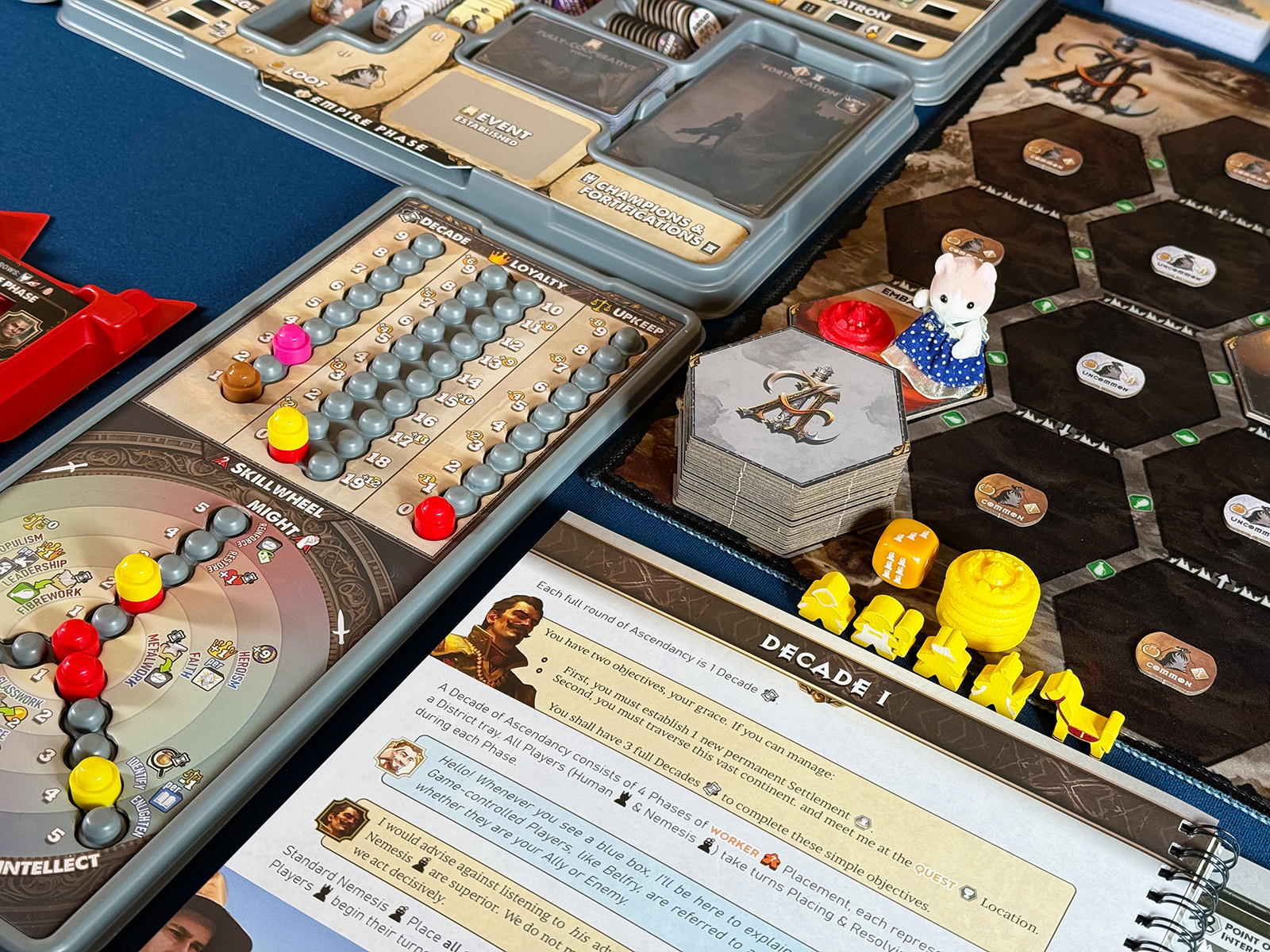
Lead a family throughout the decades to claim power and expand across the land in the scenario-based play of Ascendancy.
There are some board games I’ve played multiplayer, but set aside for solo. At last, I felt like I was ready to investigate the solo side of Ascendancy! This sprawling set of trays and components is designed to simulate a royal family and all of the options to play across many in-game years. It offers a lot of everything… Which I was hesitant about, but onward I went!
Spoiler Alert
There are some details about the tutorial scenario that may be spoilers if you haven’t played through it yet. This is mainly focused on the second half of it. Just a note in case you’re looking to play through the tutorial with no surprises revealed!
Game Overview
Game Name: Ascendancy
Publication Year: 2024
Designer: Matthew Meeple
Artists: G. Minkov, A. Nanitchkov, T. Nguyen, & M. Petrov
Publisher: One More Turn Games
Solo Mode: Included in the Base Game
Leading a family requires choices across areas like exploration, construction, combat, and recruitment. An interesting skill wheel provides clever choices, and a lot of the game experience can be tailored during setup. There is a lot to understand, and plenty of different options to explore!
First Play
March 15, 2026
Complexity
3
Latest Play
March 15, 2026
Expansions
0
Setup Time
20 Minutes
Lifetime Plays
1
Play Time
1 Hour & 30 Minutes
High Score
N/A
Game Area
42" x 30"
Low Score
N/A
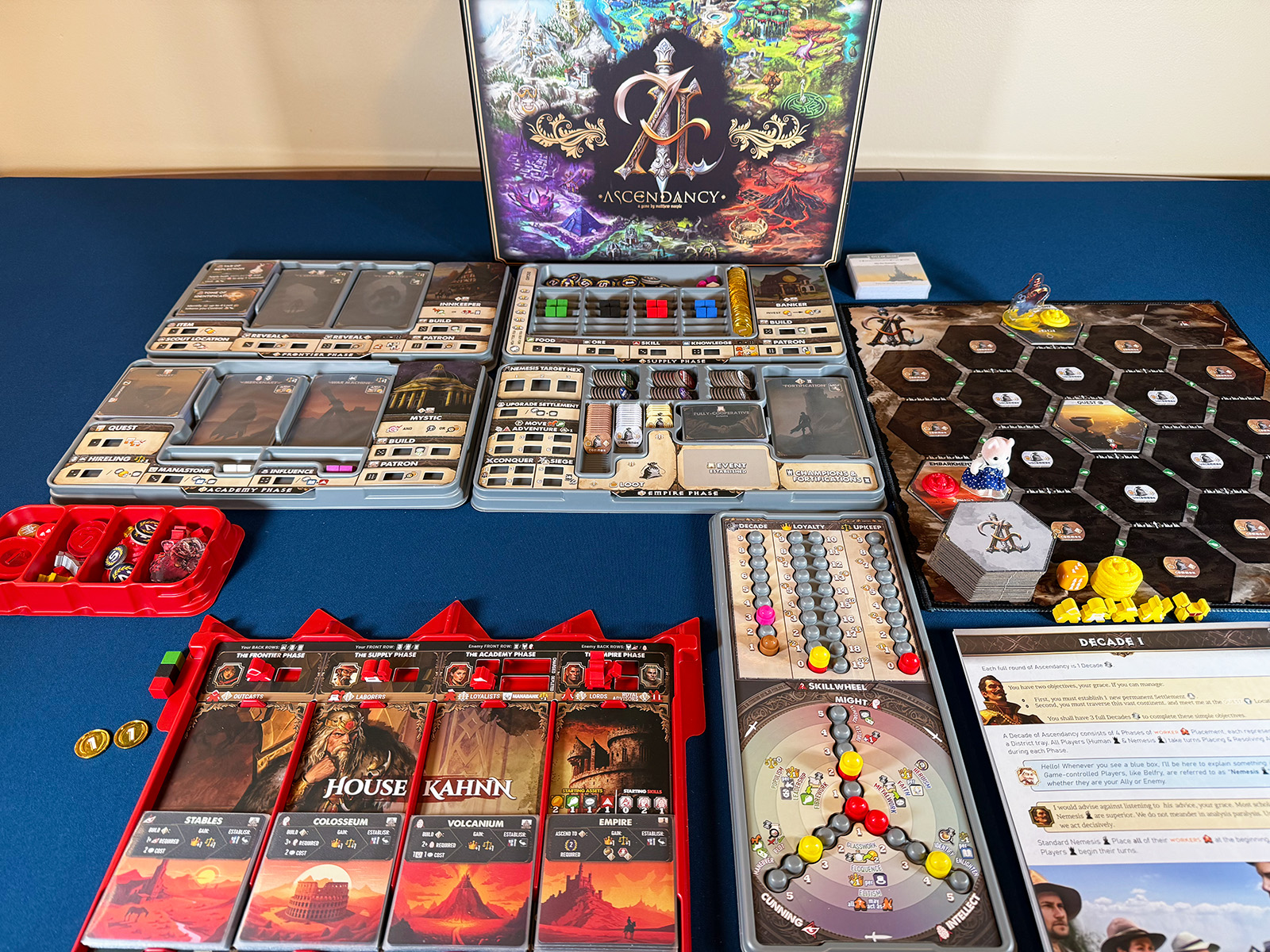
An Enormous Space
While I appreciate storage trays that can be placed on the table, setup still took a very long time. So much stuff! I was also struck by how dark and drab a lot of the cards looked.
The learning process is laid out in an unusual way. The tutorial scenario is supposed to be where to start… Yet I was immediately tossed over to the main 114-page rulebook.
It’s a lot. But also… Not a lot? The game itself felt pretty straightforward with tons of exceptions and rules outliers.
Still, I was interested in the general premise and wanted to see if this was going to be as much fun as my 2-player plays.
Uncomfortable Art
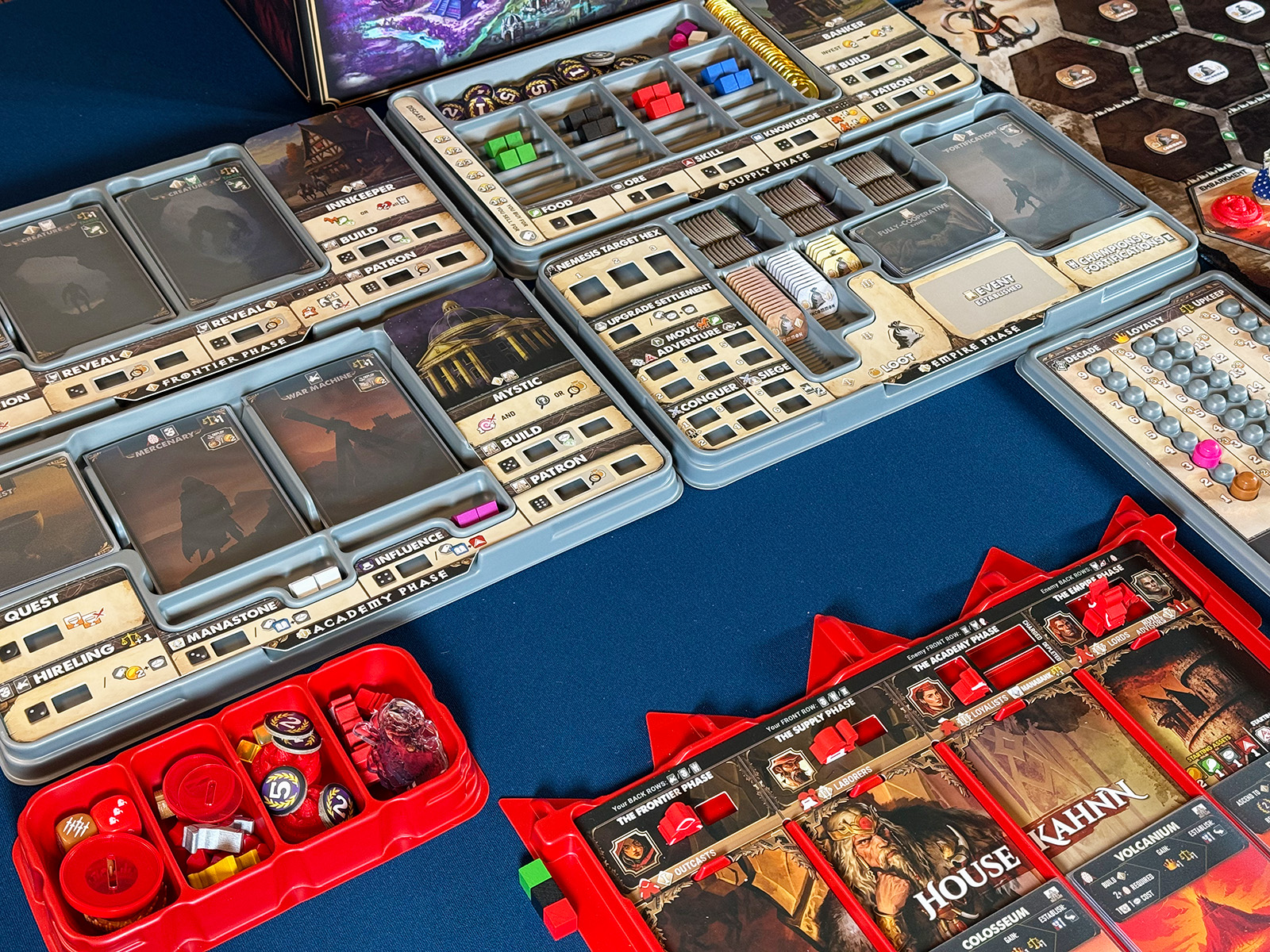
I’m not an art critic and I fully understand that every game’s artwork is going to be extremely subjective. Yet I have to say that this is a game whose appearance is… Uncomfortable?
Ignore the neon-colored hair in a setting that seems more medieval. Ignore the hand that turns into a sword, in what I can only describe as reminiscent of Terminator 2. No…
Look at the background on the right side. What? What is happening over there?! Blurry, low-quality yelling people.
And disconnected arms? This is a main piece of artwork and I felt confused and rather uncomfortable myself.
Skill Wheel Choices
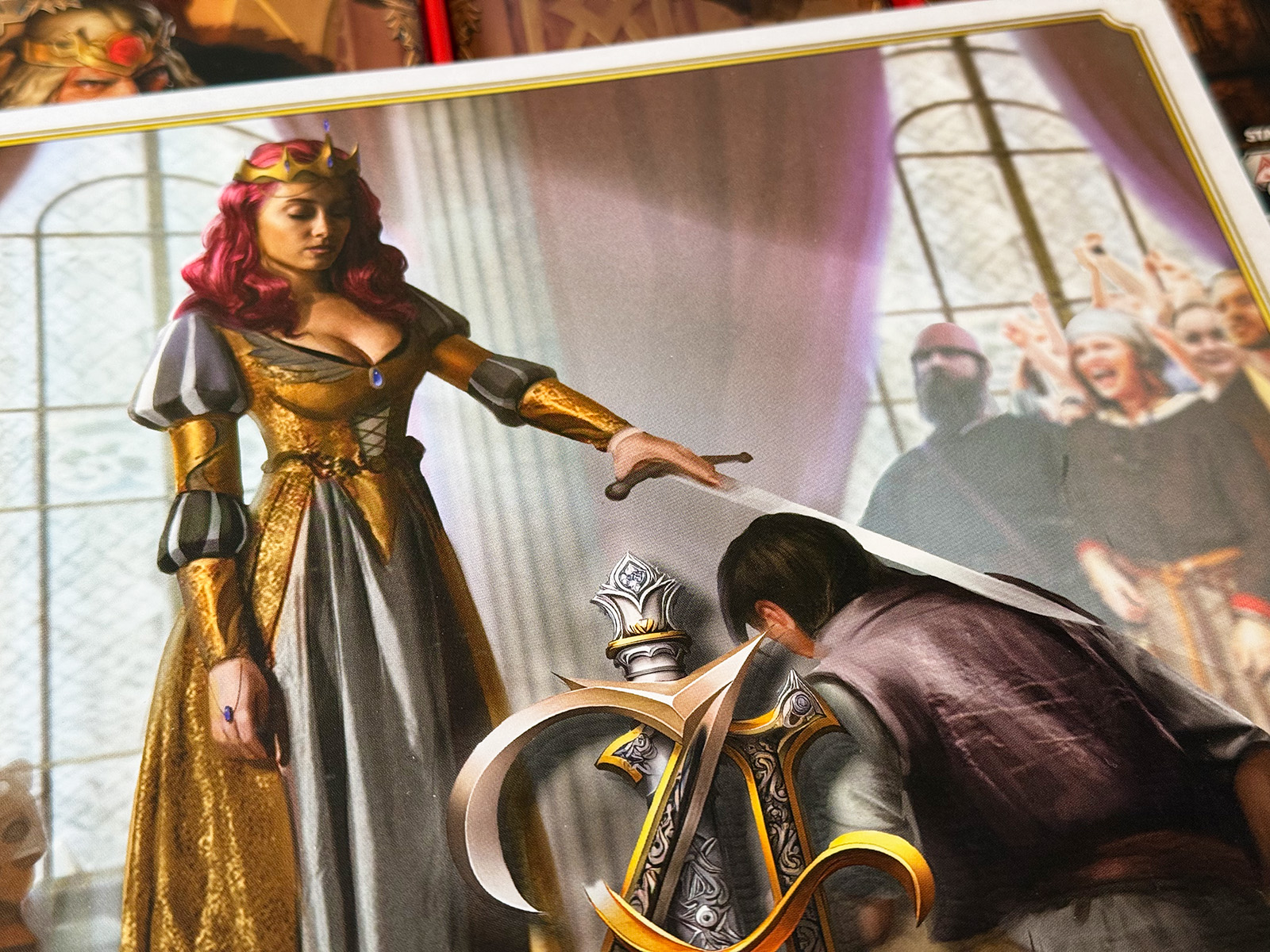
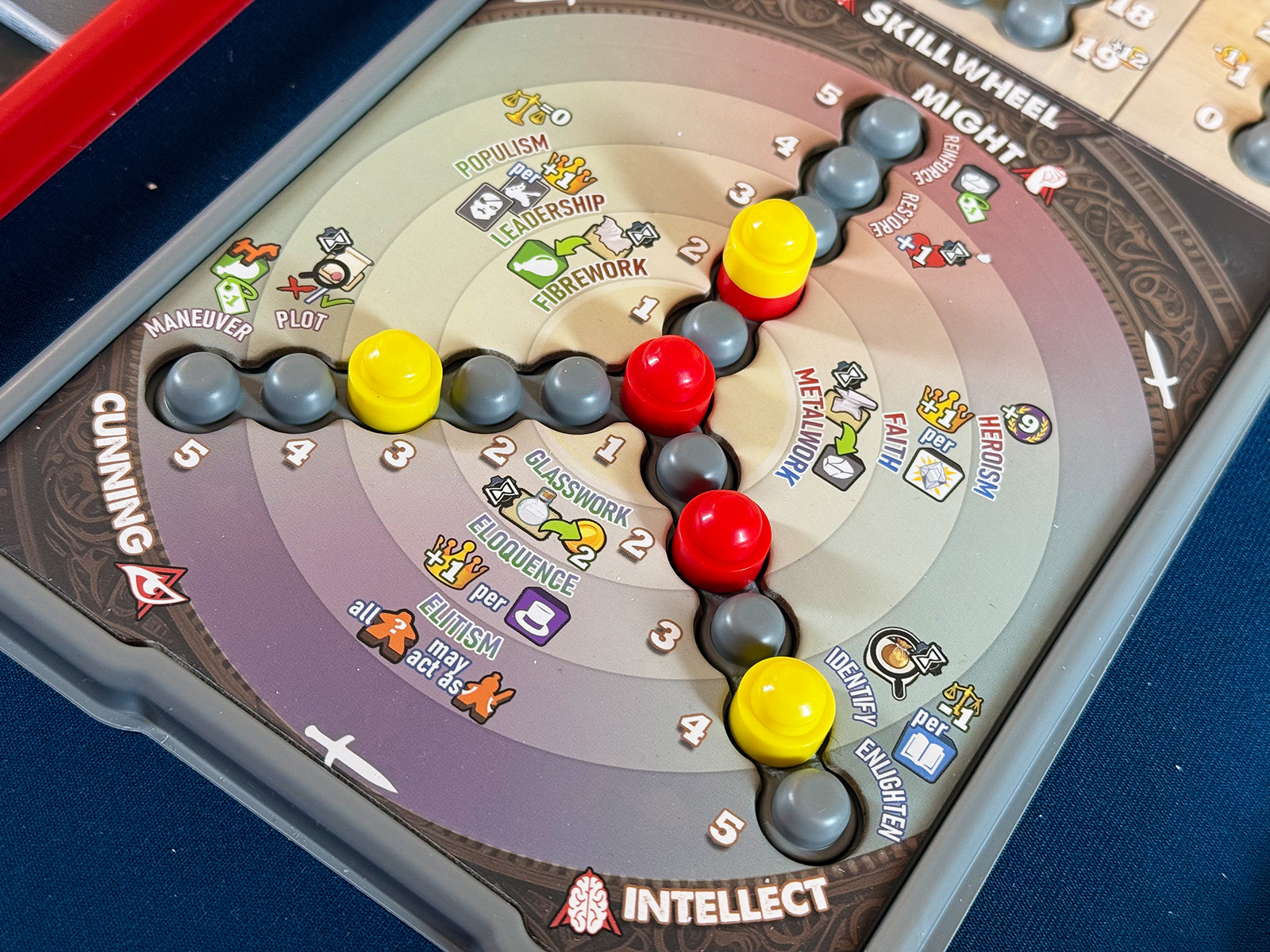
One of the elements I enjoyed was the skill wheel. There are 3 traits, and each play can see these evolve in unique ways.
Special abilities are unlocked at some of the highest levels, but the connections are also interesting. These interact and can unlock bonuses when advancing along multiple tracks.
For instance, my house began with metalwork unlocked with might and intellect at slightly higher levels.
But the icons definitely threw me off. Some of these were defined on the back of the rulebook, but I had to hunt down others. The language of this game… Was not easy to learn.
A Starting Tutorial
Every play utilizes a scenario, but there is no connected campaign. Since it had been awhile since I played, I wanted to see how the tutorial worked out as a solo experience.
This takes up a huge portion of the scenario booklet. It’s a lot more scripted than it appears, too. “Roll the die. If it’s not a 6, it magically becomes a 6!” Why waste my time rolling?
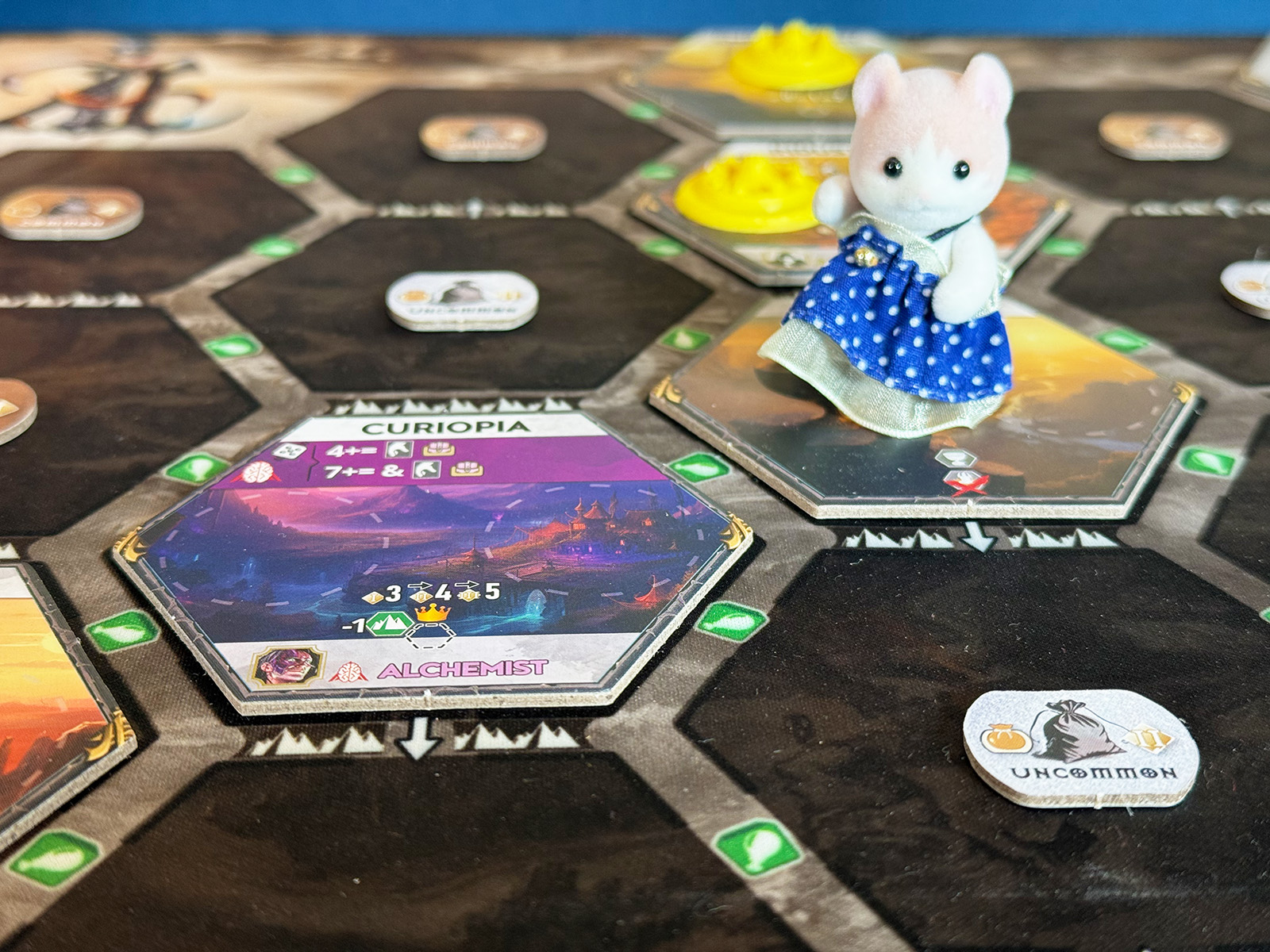
A quick glance should indicate I had high hopes… There was a Calico Critter to explore the land! But my goodness.
There is both so much here, and so little. I sighed as the tutorial acted like an introduction to basic game mechanics.
Too Much To Do and No Way To Do Any of It
I know it might be too soon to judge this one after the tutorial, yet I was so thoroughly annoyed most of the time. I think that might be the word that describes a lot of the experience… Time. I felt like I wasted it setting up things I wouldn’t need, hunting down rules in the rulebook I wasn’t supposed to need for the tutorial, or changing things that already happened.
This isn’t the largest solo game I’ve played, but it takes up a fair amount of table space. There are a lot of different actions, yet the tutorial has a very clear path. There’s no way to deviate or explore anything else. So again, I know another scenario is probably going to improve things. But the whole setup process involves important decisions and no guidance.
How many decades to play? That’s up to me. I have no idea why I would want to choose a short vs. long game. Is one of those supposed to be better? Do the scenarios have recommendations? Just flipping through a few scenarios made me realize I wasn’t going to find any joy here. There are too many ideas, and none of them feel like they were streamlined.
Feel Free to…
One of my biggest issues with the game is how it promises all of these systems and ways to advance. There are buildings to construct, quests to complete, and more.
Right near the start of the rulebook, I want to highlight this one section: “… feel free to skip combat …” It’s there.
And yet combat is required. The tutorial forces these options, and ends with a giant battle. Other scenarios follow suit. Maybe not all of them, but combat is a central focus.
I don’t mind combat in these sorts of games, yet I strongly dislike being made to think a choice exists when it doesn’t.

Action Choices
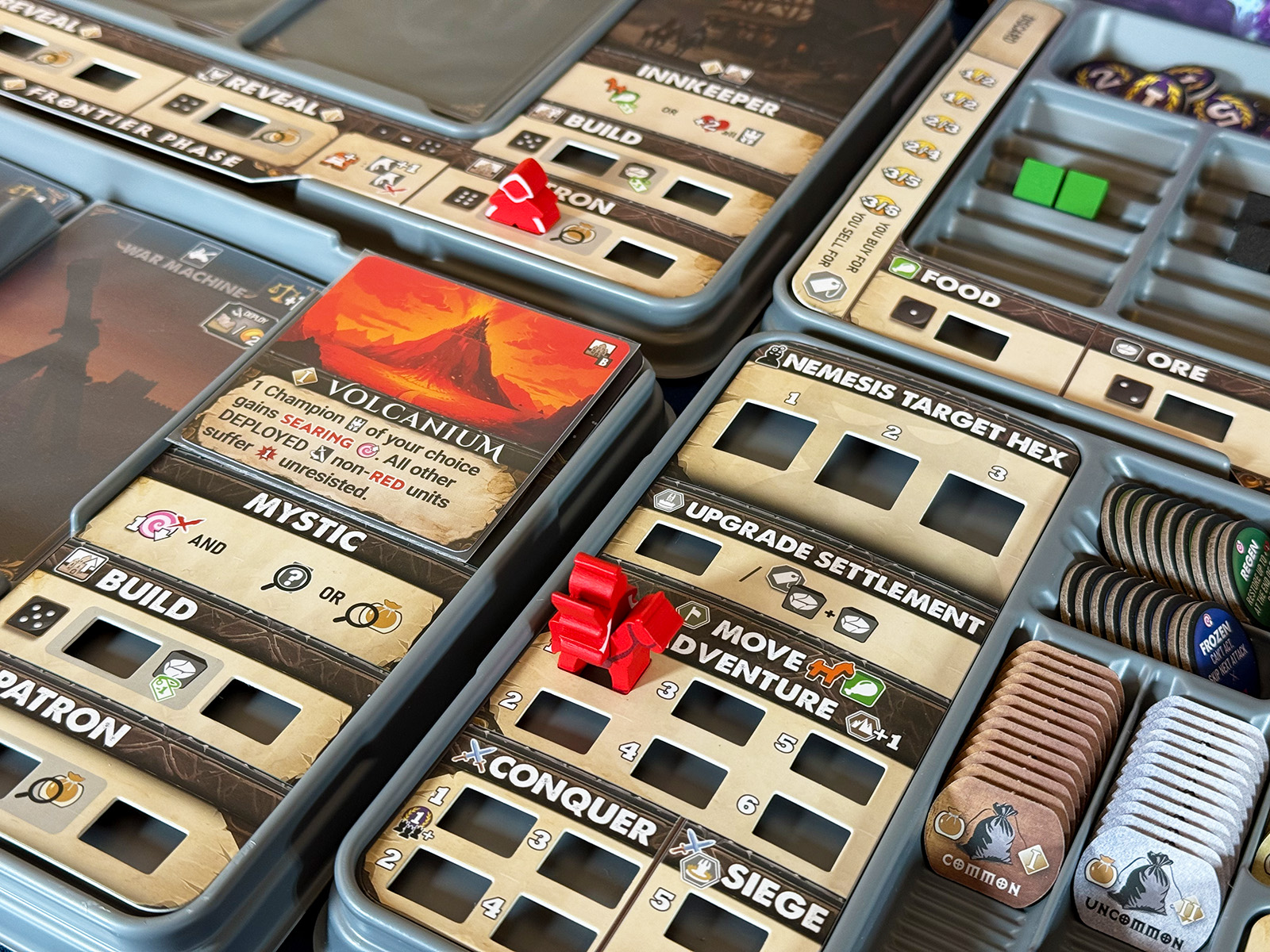
Gameplay moves through various phases, where actions are chosen and resolved. There are some neat ideas here with the various options and ways workers can be placed.
Effectively, a worker is a certain tier and may only act in phases that are equal to or lower than their tier. This can be really cool for building up for long-term planning.
Yet the tutorial doesn’t allow this to happen. I had to place each worker exactly as I was instructed to for basic actions.
There was a situation when I finally had free reign… Only to be forced into a choice at the end of my turn. But why?!
An Empty Map Space
Since the tutorial follows a set pattern, the map ended up pretty empty by the time I reached the finale. Once again, I wondered why I put tokens on spaces I would never reach.
I never felt like I was learning how to play. Sitting down for an hour to read through the 100+ page rulebook was more helpful, although it was lacking in the example department.
There were some fun ideas here, yet I never enjoyed myself. Even flipping over tiles didn’t feel like an exciting discovery.
What was I doing out here? It all led up to a final battle, which again emphasized how combat was a main element.
The Mad Vizier
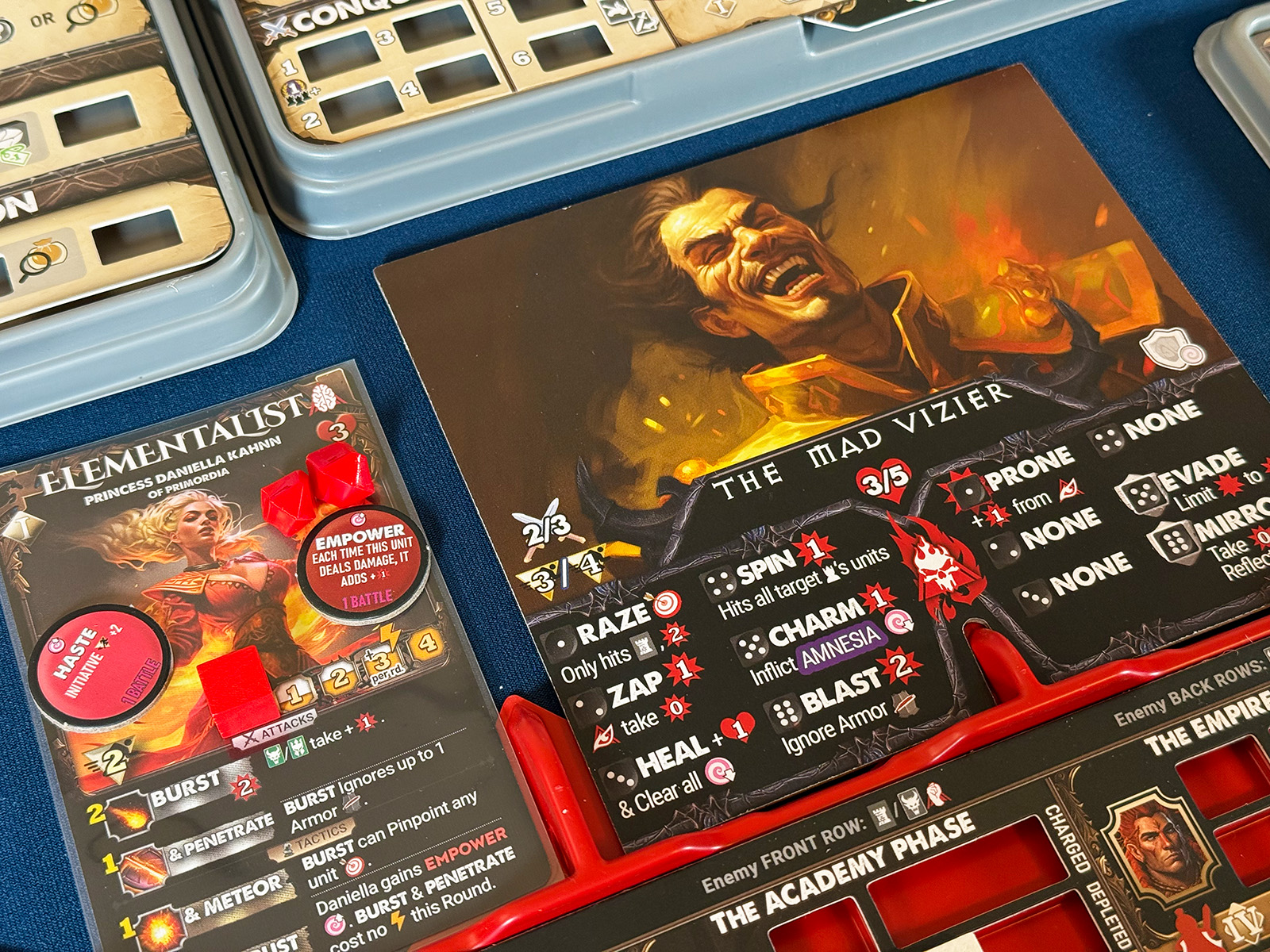
Throughout the tutorial, there is a mixture of instruction and flavor text. One character is made out to be a villain, yet in a way that’s not fun. I didn’t enjoy reading the dialogue.
And then this giant battle commenced, with a messy mix of abilities to activate and dice rolls. I did a few neat things to defeat the Mad Vizier, but I only succeeded through luck.
I know the later scenarios are more open-ended, but I had no desire to continue. This brought me no joy at all.
There were glimpses of interesting ideas, yet I was more excited to clear it off my solo table. Onto something else!
Session Overview
Play Number: 1
Solo Mode: Included in the Base Game
Play Details: Scenario 0
Outcome: Complete
The buildings seem to be interesting with their increasing tiers and better abilities. But again, I couldn’t get past the jarring artwork shift. There were lots of possibilities, yet this experience felt all over the place. A tutorial doesn’t need to showcase the entire game… However, it should draw me in and encourage me to explore. Rather a shame for the price of this miniatures version when I used none of them.

%
1 Play
Affordability
Price & Value
1
Functionality
Challenges & Mechanics
7
Originality
Design & Theme
3
Quality
Components & Rules
4
Reusability
Achievement & Enjoyment
5
Variability
Distinctness & Randomness
4
+ Pros (Positives)
- The skill wheel is a neat idea that encourages exploring a focus on one or multiple traits to discover the abilities.
- Spiral-bound books are easy to navigate and fold over, especially since they’re both very lengthy with lots of flipping.
- Action choices offer a lot of possibilities with the sequence of play, allowing some short-term and long-term planning.
- Worker tiers allow more layered decisions since investing in a single phase can be very helpful for future rounds.
- There is a good deal of variety in the different cards that are available, offering plenty of options to choose between.
- Although the iconography can be tricky, cards with text are reasonably straightforward and easy to understand.
– Cons (Negatives)
- There is so much across tons of components, yet gameplay isn’t necessarily as open-ended with required combat.
- Although the tutorial introduces concepts, it’s very scripted with some frustrating decisions surrounding the steps.
- Setup is supposed to be helped by the storage trays, yet there is a lot to do and the overlays warp very easily.
- A 114-page rulebook without an index is difficult to wade through, and it lacks clear examples of important concepts.
Victory Conditions
Complete the Scenario
- Overall Goal Progress 100%
Goals and Milestones
Complete Scenario 0.
Continue the Conversation
What do you like about Ascendancy? Is there a scenario or family you enjoy? I had hoped to find some fun from this one, especially since it’s so vast and offers so many different paths. Alas, it was an unfortunate experience and a game that somehow doesn’t work for me in practically every way. Still, these are good lessons and I can find something else to play!
Hey thanks for sharing.
The Tutorial is designed to teach how the core game loop works. It’s a deliberate ELI5 hold your hand as you go through the motions, rather than free reign like the non-tutorial Scenarios do. I understand not everyone likes that. But it proved the best way to get new players up & running during blind testing.
I originally tried to make the Tutorial less “on rails”. But because there are so many decision points, it became impossible to provide clear direction for all the possible outcomes.
Appreciate your comments! It just didn’t work for me and didn’t make me want to play the game again. It felt like the rulebook pointed to the tutorial as the definitive starting point for every player, even though it feels less geared towards experienced board game players. Hopefully, it works better for others!
And if you don’t mind posting a spoiler warning for the end bit I’d appreciate it!
I added a spoiler alert to the post. Thanks!
Same expérience there although it was my first play.
The problem is not the tutorial is on rail, the problem is the tutorial is not respecting your time, not engaging and the game design is a sprawling mess of ideas that you need to constantly refer too.
In that regard I found a it much worse than cloudspire which at least has proper reference sheet although you navigate through them a lot you don’t have too much to search
Anyway.
I’m looking forward to trying out Cloudspire solo at some point! There’s a lot to it, as I recall from playing it multiplayer, yet it felt reasonably clear to me. Here’s to hoping we both have some great game experiences ahead!