Into the Realm of Monumental and Historical Wonders
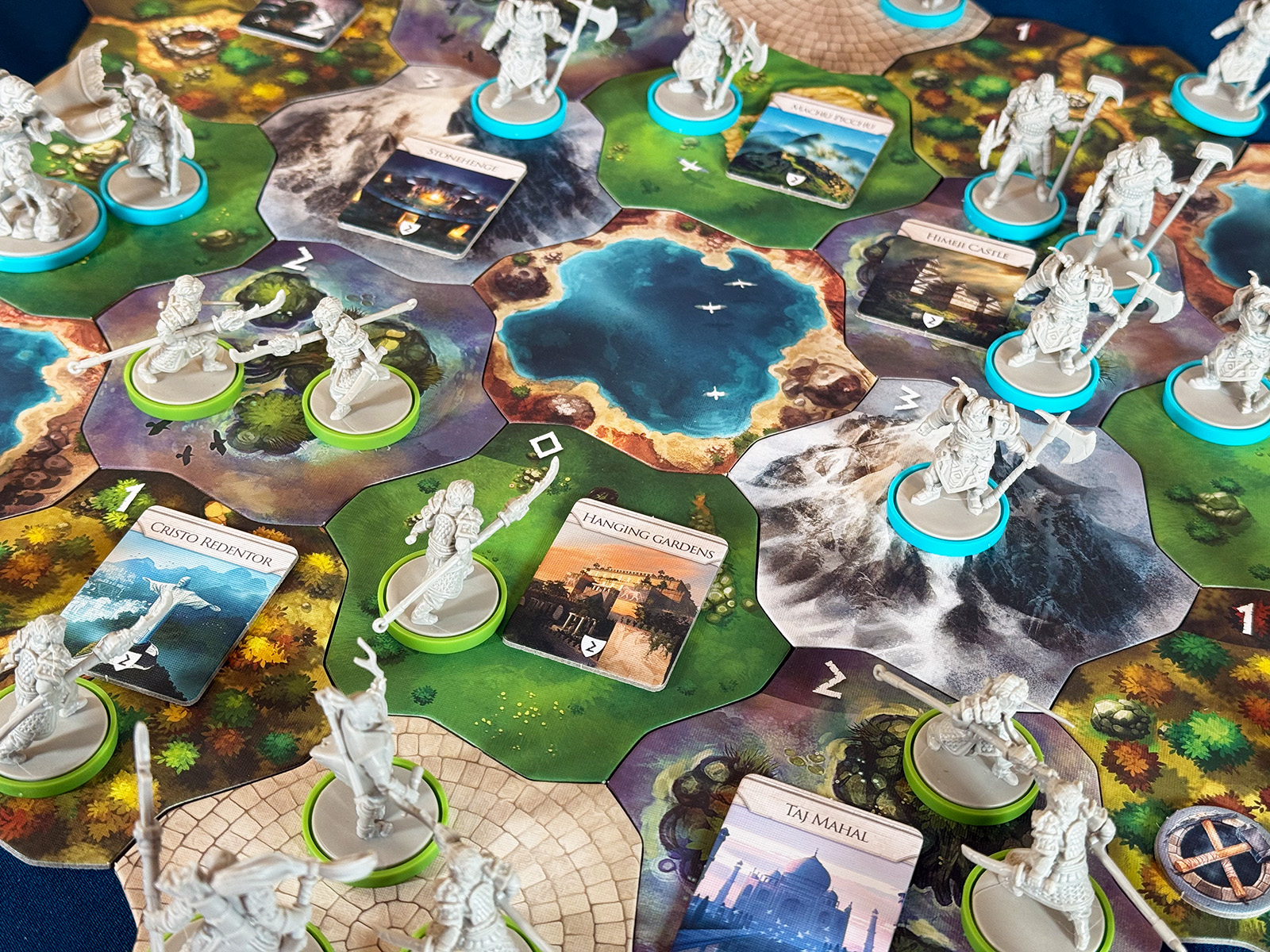
Grow an ancient civilization with all kinds of technologies and wonders to expand at a small and large scale in Monumental.
There are times when I feel ready to tackle a sweeping epoch of building up a civilization. I had the desire to learn a new solo game, and settled on Monumental! Although there are a few expansions that add more options and modules, I stuck with the base game to get an idea of how the map and capital city mechanics would play out. Onto a grand adventure!
Game Overview
Game Name: Monumental
Publication Year: 2020
Designer: Matthew Dunstan
Artists: Many (9 Credited)
Publisher: Funforge
Solo Mode: Included in the Base Game
A civilization’s capital city offers a grid of cards, and choices activate actions and resources throughout the rounds. New cards from the market offer interesting combinations, as do all of the options for expanding across the map! Finding ways to reach victory can be an interesting solo challenge.
First Play
April 11, 2026
Complexity
3
Latest Play
April 12, 2026
Expansions
2
Setup Time
15 Minutes
Lifetime Plays
2
Play Time
45 Minutes
High Score
34
Game Area
38" x 30"
Low Score
3
To the Capital City
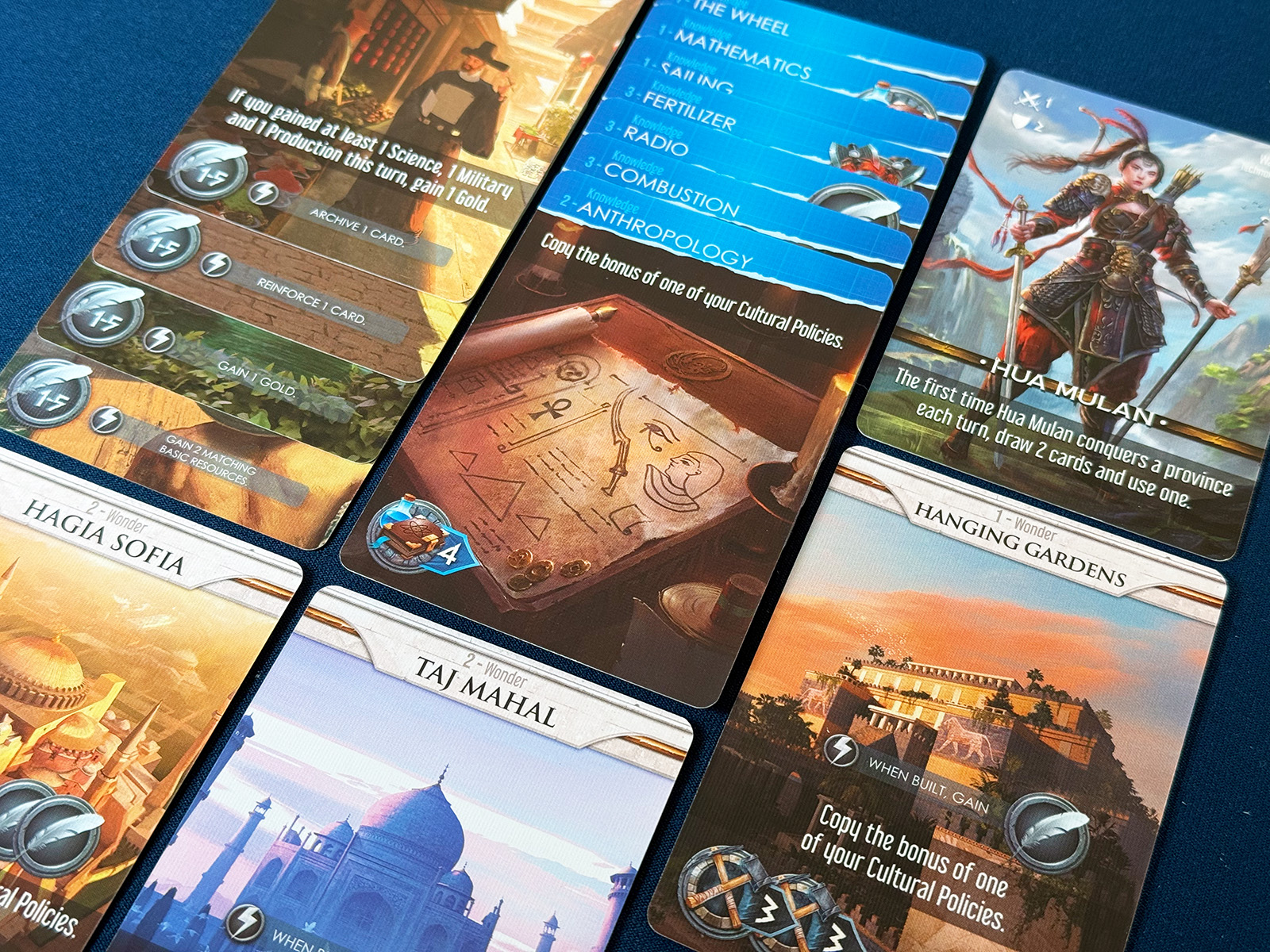
I chose to play as the Chinese, while my solo opponent took on the persona of the Danish civilization. Such incredible artwork! I loved the appearance of all of the cards.
One of the core features of gameplay is a capital city. This 3×3 grid is how cards are used each round. But there’s a catch: Only 1 row and 1 column may be activated at a time.
Quite a neat idea! Cards not chosen remain for the next round. This introduces neat timing and planning ideas.
If this was the game, I think I would have really liked it! But there was something larger on the horizon to manage…
Looking to the Map
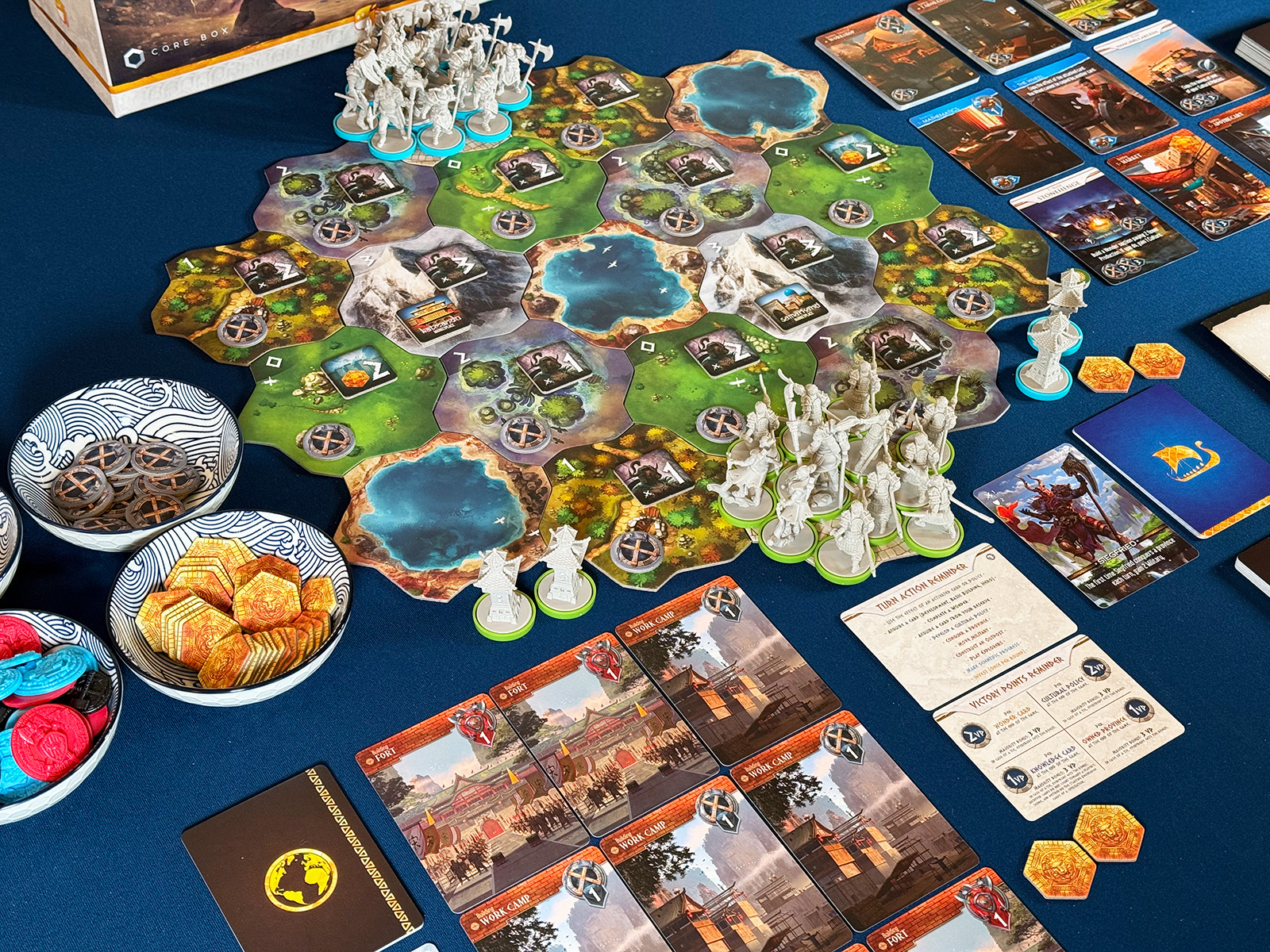
A lot of action takes place on a modular map that is built during setup. There is a booklet with arrangements that doesn’t clear specify the amount of each component.
I painstakingly had to look at a diagram to figure out what to place on 19 hexes. Why this design? It took up the least amount of table space, but it could have been much larger.
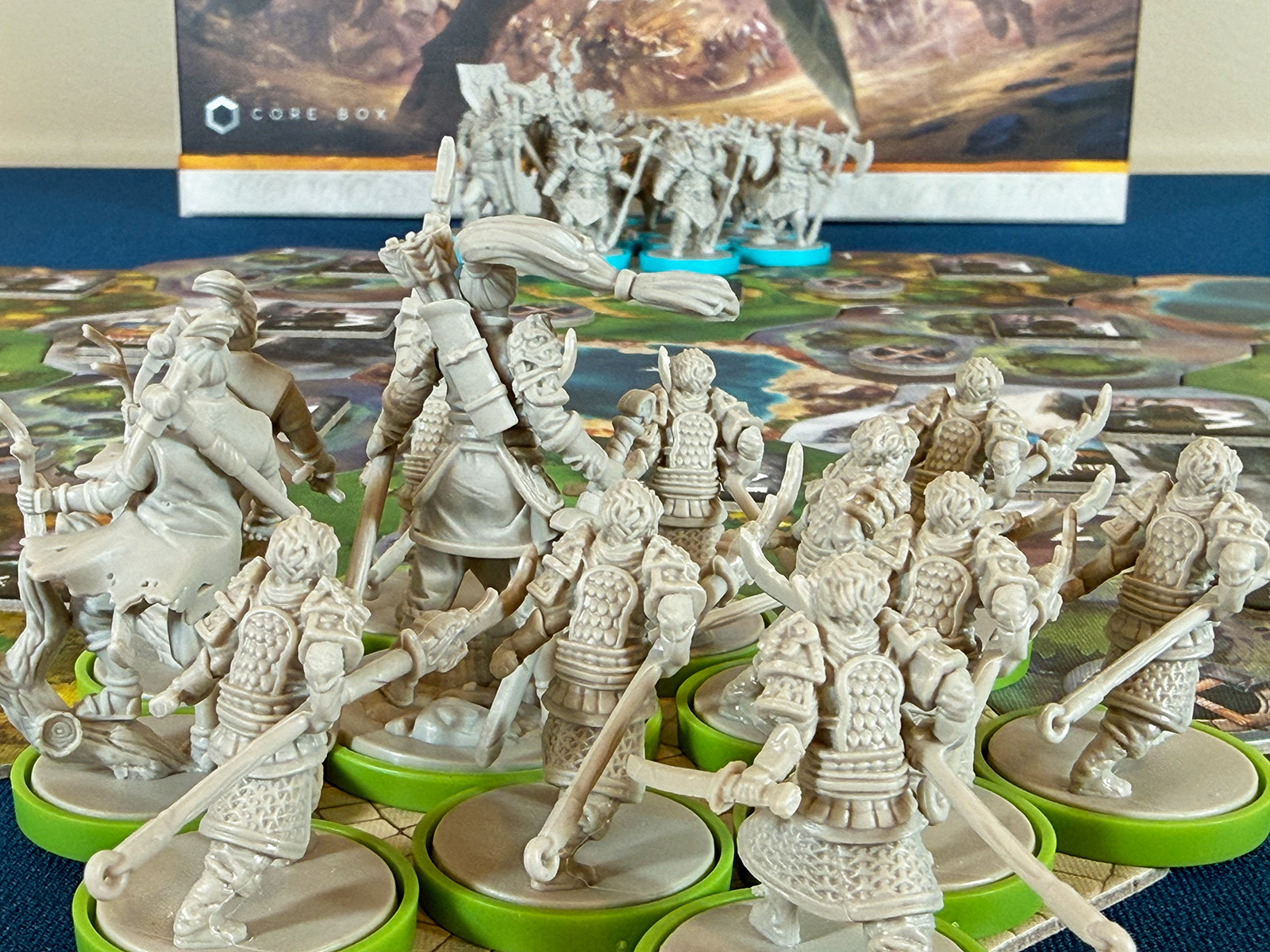
Setup was not great, and the area quickly got cluttered with large miniatures and tokens. Not at all a fun part of play.
It felt a bit unsettling to have a neatly arranged capital city and a messy sort of map situation. Yet onward I went!
Market Choices
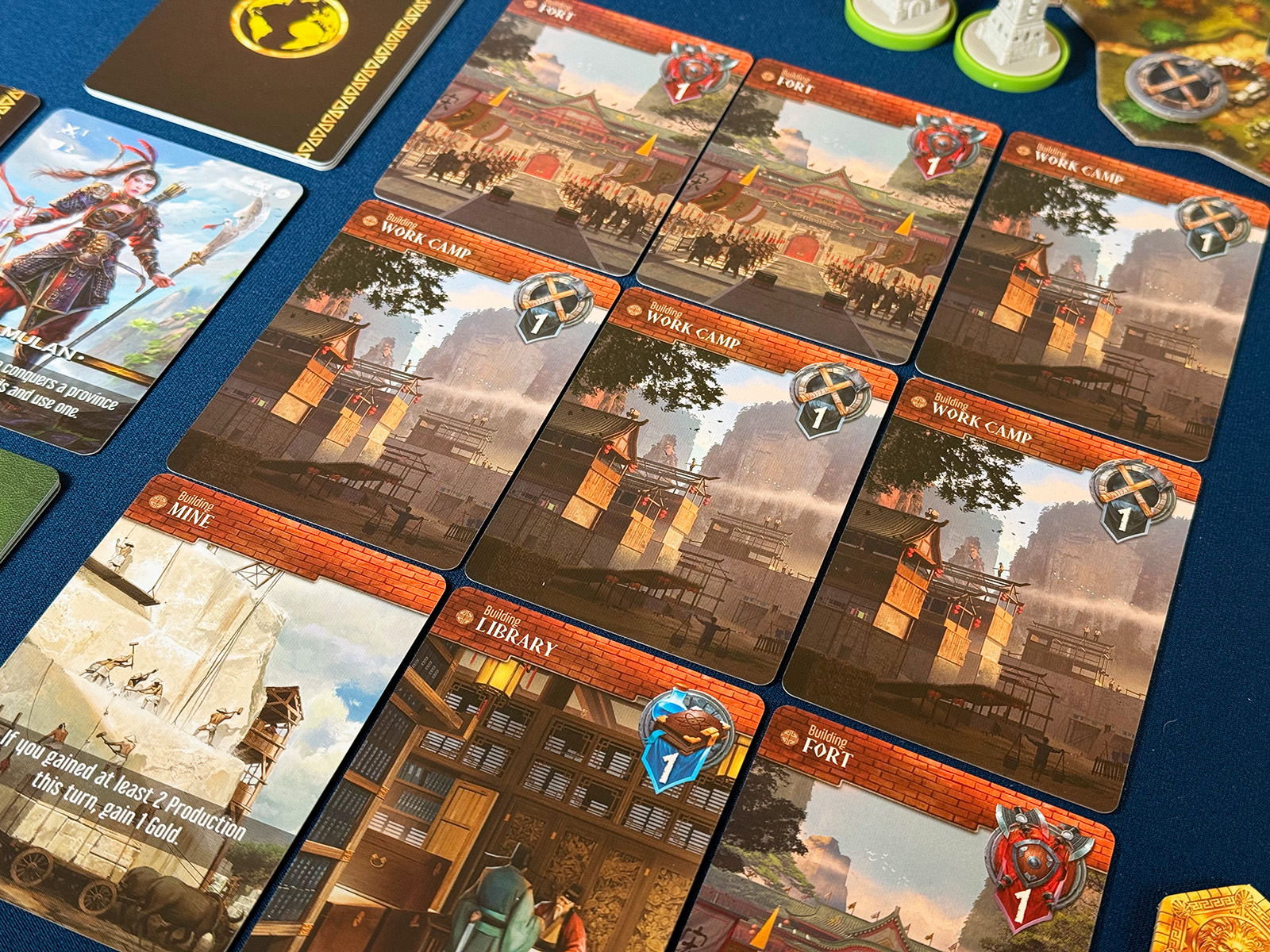
Purchasing new cards helps expand a capital city, adding to the possibilities and allowing for much stronger actions.
This was a neat concept, although the solo mode is a little more about denying the solo opponent opportunities. I kept my basic building purchases to a minimum.
Different ages offered more powerful cards, although I wasn’t at all connected to the theme. I’m not sure how we built these wonders so close together… Not very realistic!
Which is an interesting point. I thought there would be a connection to history. Only theoretically, I suppose.
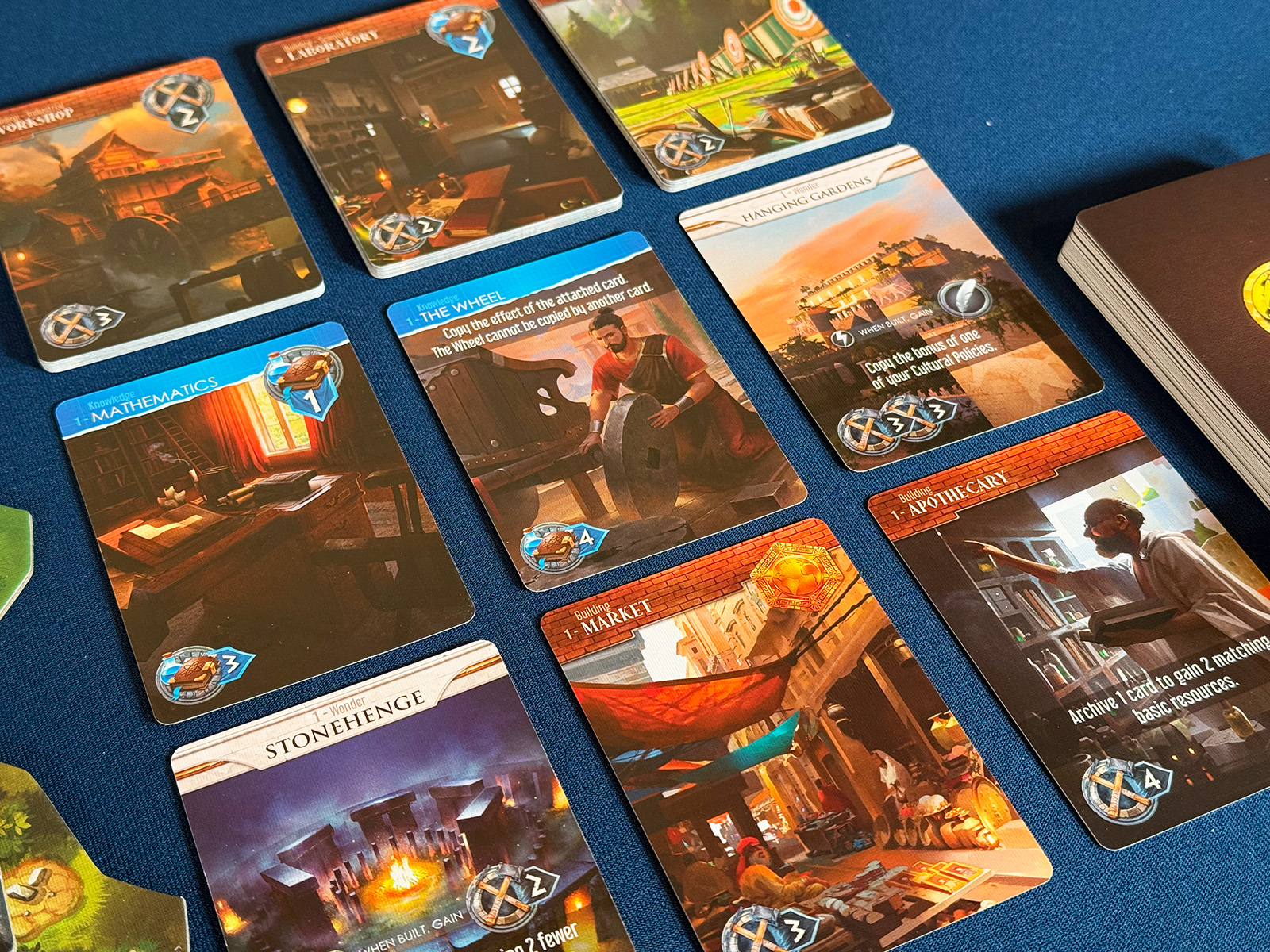
Wondrous Places
The map wasn’t necessarily overly busy once a bunch of tokens were removed, but the solo opponent evaluated a lot of hexes each round. I had to do a lot of counting. So much!
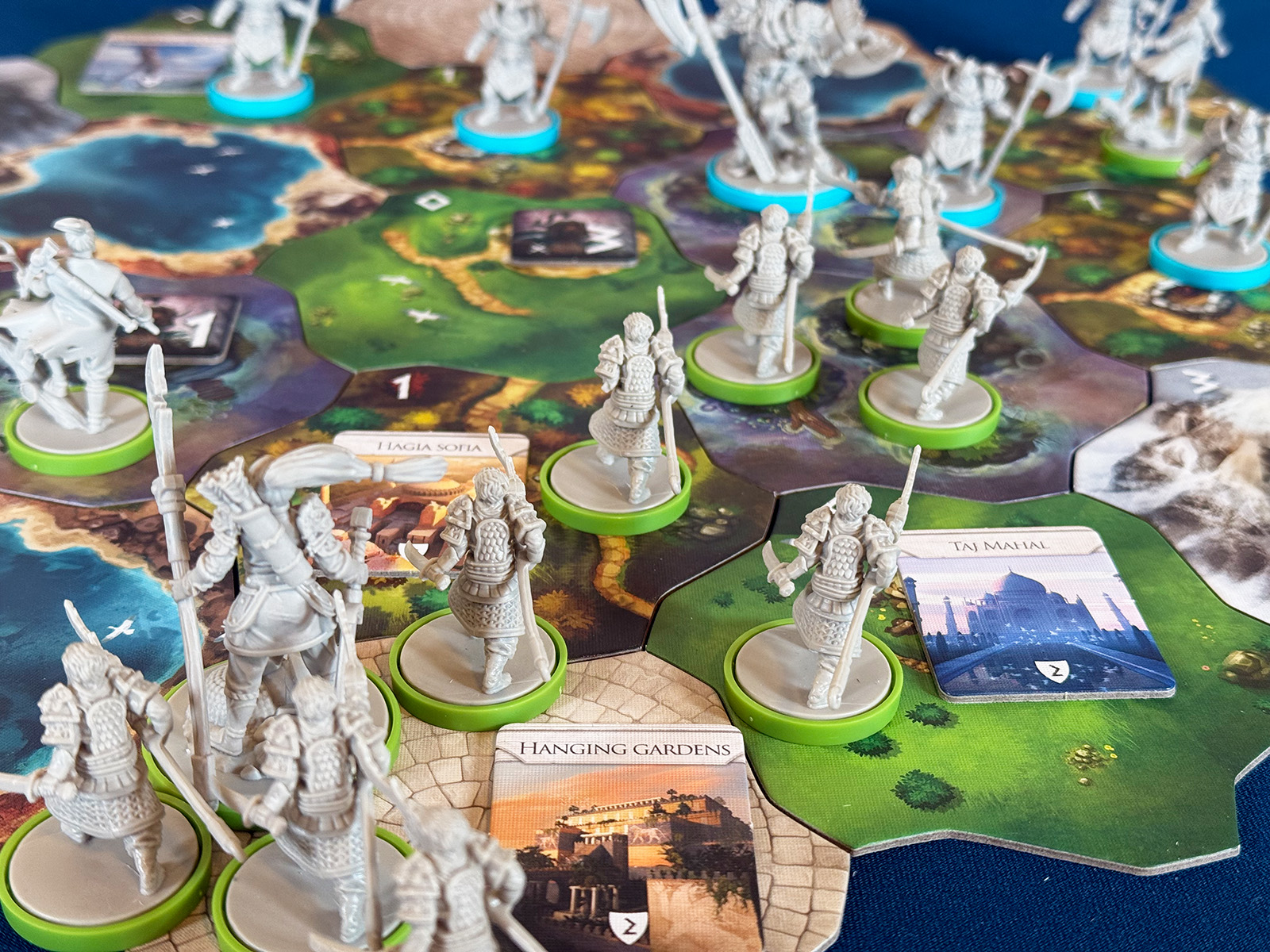
It was also a little jarring to see these monuments out on the map. They got lost in the busy artwork a bit, yet again, I wasn’t sure how these were adjacent to each other.
Seeing the wonders was awesome, though! I just wish there was a little more of a tie-in to a civilization’s real history.
Since the Danish solo opponent was focused on expanding and conquering, I was just happy to claim a small area!
The Importance of a Clear Rulebook and Setup
I seriously struggled with the rulebook in a number of places. First, I didn’t find the component list until the very end… It’s a text list at the back of the rules. Unboxing the game was a nightmare because I didn’t know how to sort the cards. That was intuitive once I started to play, yet I was utterly confused at first. Setup was all too frustrating in many respects.
Although I appreciate detailed diagrams to show a map setup, not listing the component count was painful. I had to count the number of different hexes… Then look for tokens of different values… And also check for a few other types of tokens. All on a diagram. Worse yet, the short rules for creating my own map provided absolutely no real guidance to help me out.
Many rules didn’t come with lengthy examples, and I had to piece together information to make sense of it. I also only found a tiny note about how my starting technology didn’t count for scoring… Which meant I had to look for a small icon on a single card. Also, this was a huge rule, especially for solo where the solo opponent doesn’t have a starting technology.
It felt muddled, which made me feel muddled. I thought the capital city mechanic of choosing a row and column was fantastic! The rest of the game made me feel confused and frustrated. This is not the civilization game for me.
Cards to Score
I couldn’t put my finger on it, but final scoring felt a bit odd. Almost like the map mattered very little… Which it did. 3 of the 4 scoring categories come from the cards.
Picking up technologies and wonders wasn’t too difficult, although I was outwitted a few times! I lost out on a majority in the technology area, which cost me the game.
The cultural policies were another neat mechanic that offered a way to order passive abilities and gain bonuses.
My first play wasn’t too bad! Gameplay was reasonably interesting, although I dreaded resetting to play again.
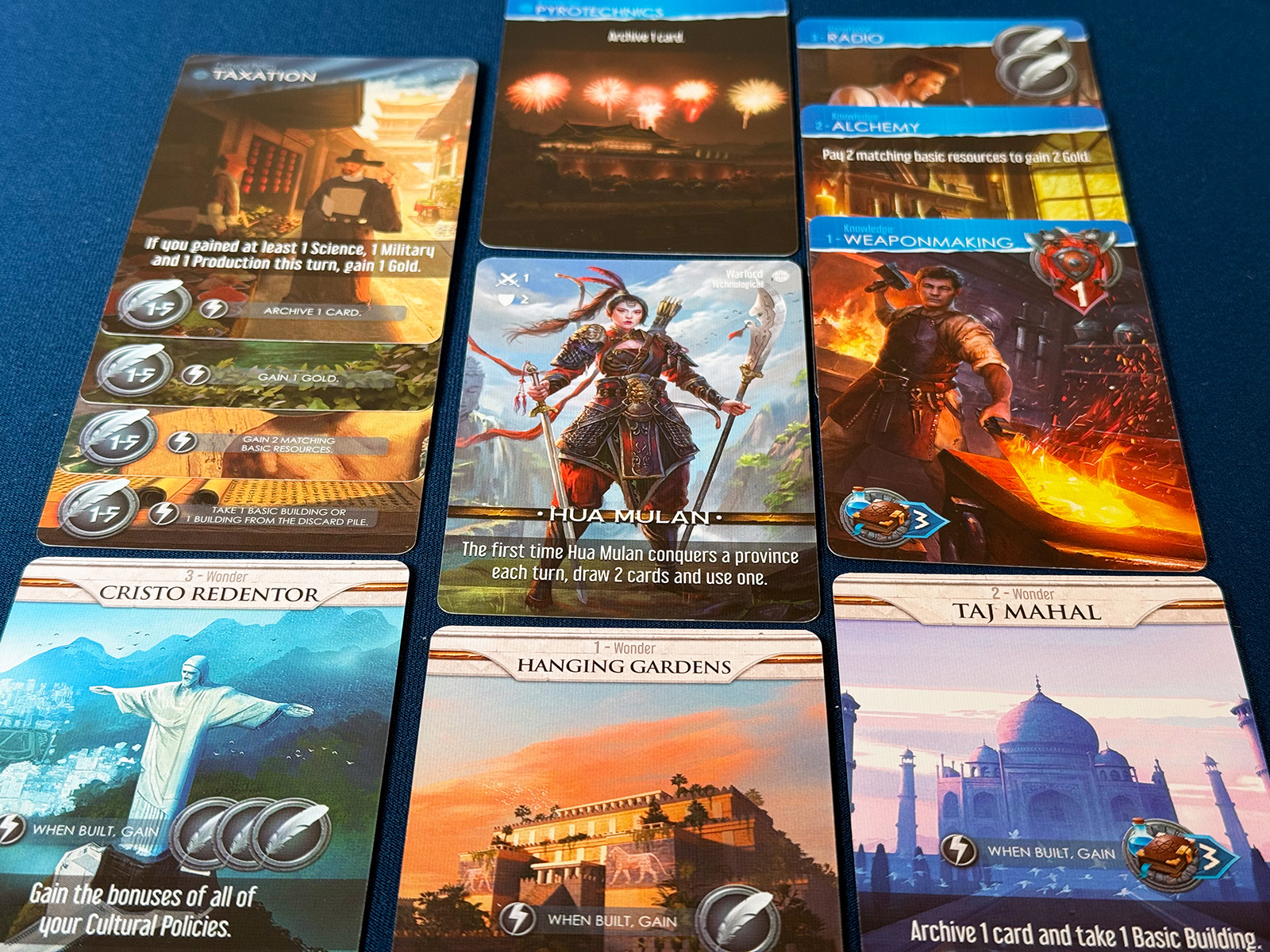
Siegfried of the Danes
The solo mode cards were mostly easy to parse, and had to do with interacting with the map or market. Each civilization has its own extra card that may show up, too.
And as leaders are a different type, every card also had a secondary action that might trigger. Siegfried was aggressive, so only those extra actions happened.
I liked it in some senses, but felt like it was a lot more work without a lot of payoff in the end. Nothing really chained.
Additionally, the deck felt rather small overall and even as I started to play again, I recognized all of the cards.
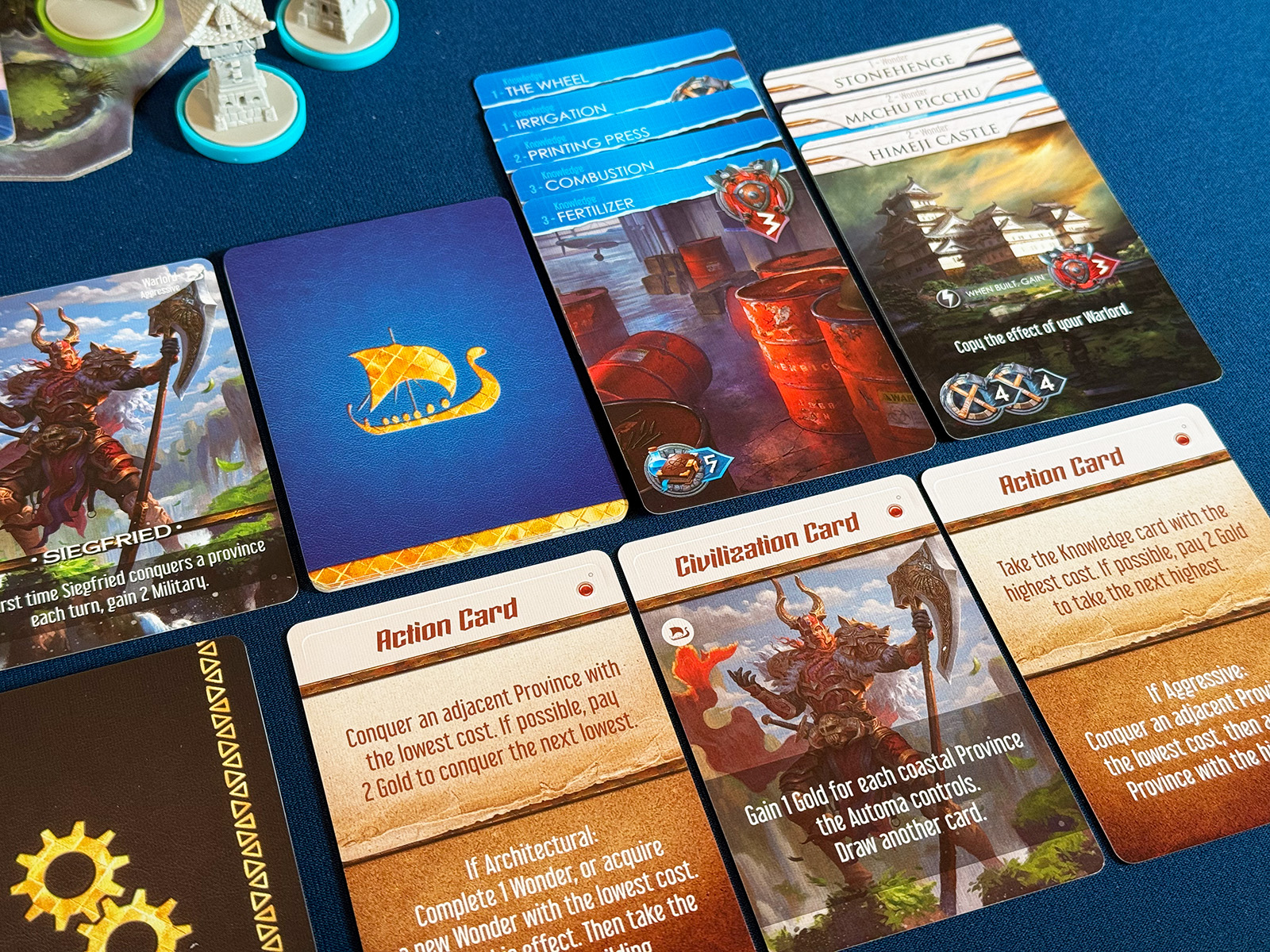
Onto a New Map Setup
Since I wasn’t particularly interested in the booklet of maps, I simply took all of the tiles and shuffled them up to make a different kind of map. Which… Wasn’t all that unique.
I kept it symmetrical around the starting tiles, and just randomized the rest. This was neat, yet the rulebook was lacking in clear guidance about how to make my own map.
Was this the recommended number of tiles for solo play? Should I have placed a lake in the center? Any tips?
This took a long time to put together with all of the token stacks I had to gather and shuffle. Just so much busy work.
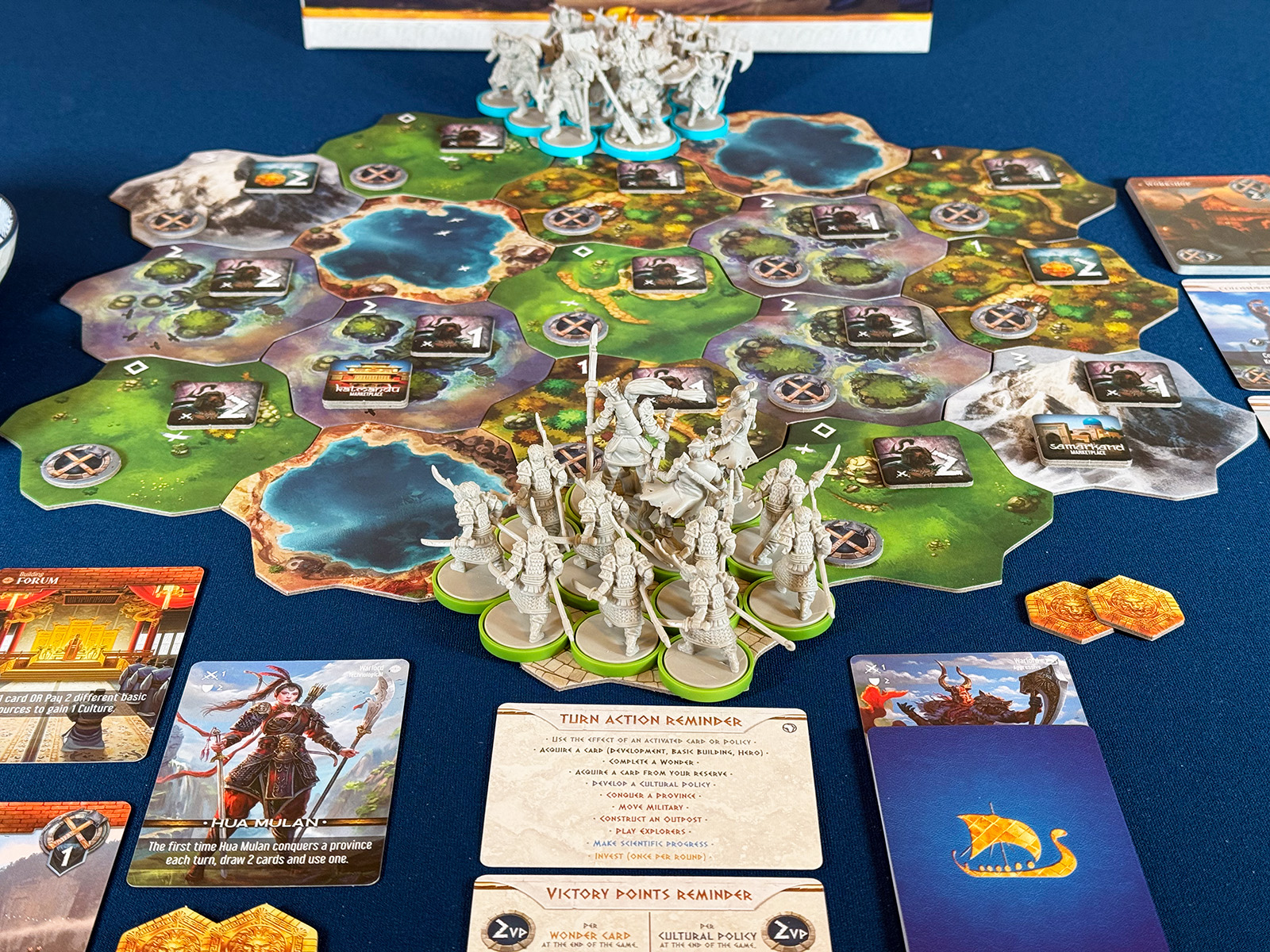
Capital City Enjoyment
My favorite aspect was my capital city. Choosing which row and column to activate each round was really interesting!
Technology cards were neat, too, as these allowed another card to stack on top of them. Yet with too many technology cards, some would be discarded without being used.
Perhaps this felt the most thematic, as I could see where I gathered resources from, like knowledge in the library.
There was some variety in what could happen every round, yet I felt like I knew how to invest in the more valuable options very quickly… Like wonders and cultural policies.
Activation Chaining
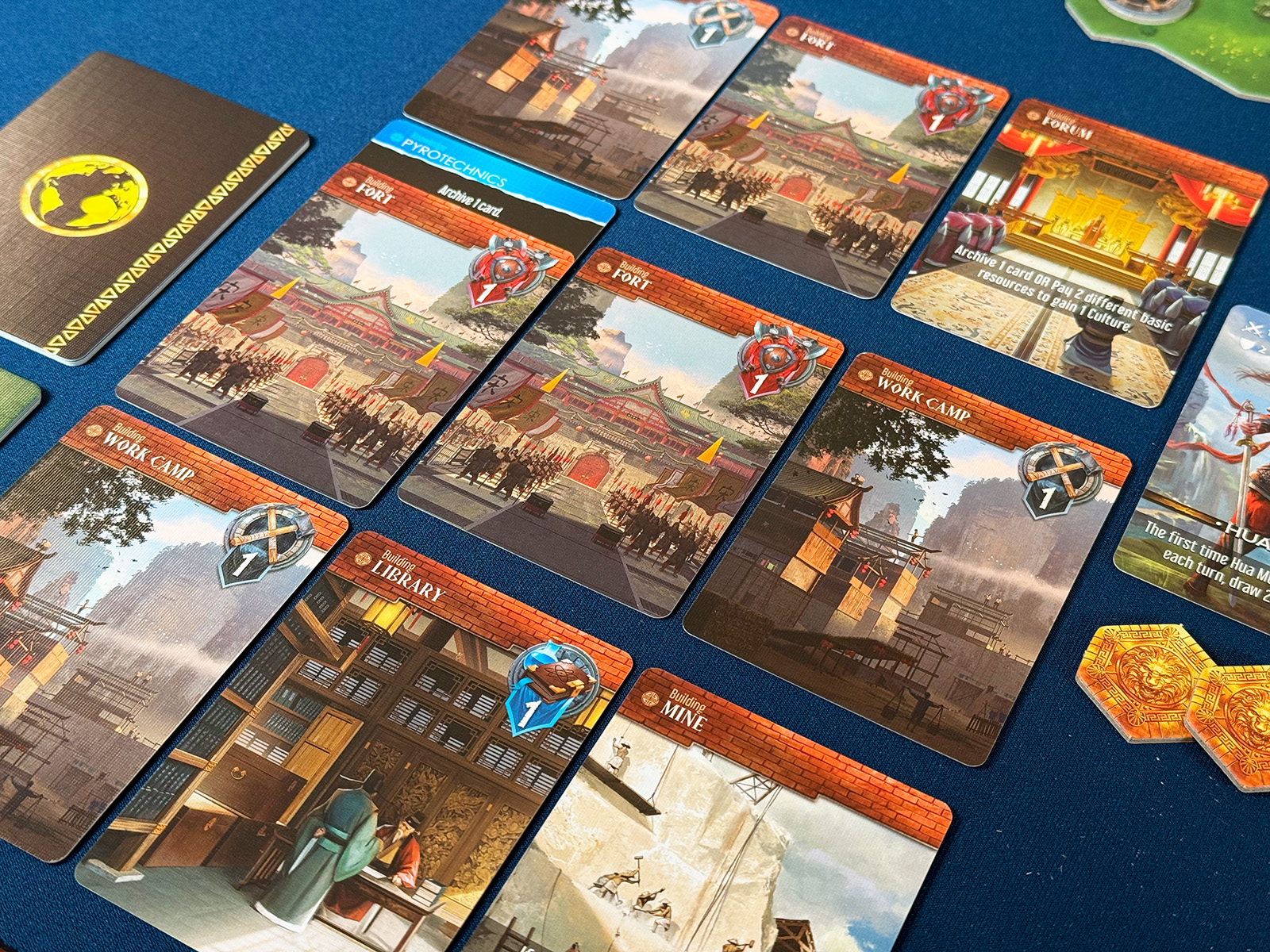
I know exactly what I did during this turn! The activated cards granted me 1 production, 1 knowledge, and 2 military.
What to do with those? Since resources don’t carry over between rounds, I used them all. The military helped me expand into a nearby hex, claiming a bonus token.
With the other paltry resources, I activated my forum card action to discard them to gain 1 culture… Which could remain between rounds, and would unlock a cultural policy.
Very cool! I really enjoyed these choices and this step was the best part of every round. If only this was the game!
The Winning Deck
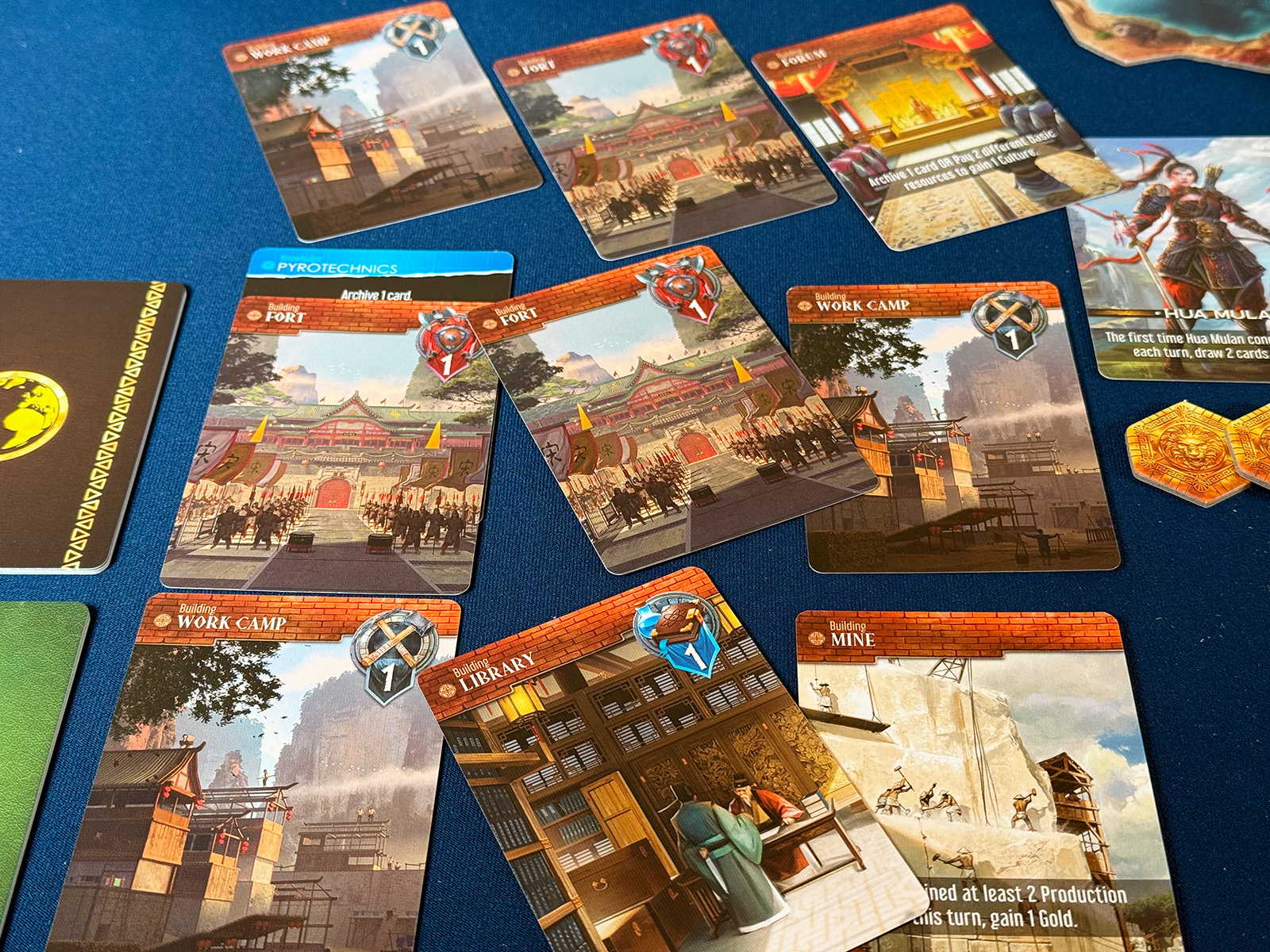
Not surprisingly, I managed to pull off a victory in my second play after I had a handle on the strategies. Look at all of those excellent cards for Hua Mulan! Plenty of progress.
The Danish civilization had a strong grasp on the map hexes, although I didn’t care all that much… I even thought I would never really focus on conquering at any point.
Some glimmers of hope came through and I really wanted to connect with the game. Alas, this one wasn’t for me.
Perhaps my sweeping civilization solo games need to be a bit more compact and focused on fewer mechanics.
Session Overview
Play Number: 1 & 2
Accessory: Monumental: Resource Counters
Solo Mode: Included in the Base Game
Play Details: Chinese vs. Danish
Outcome: 30-44, 34-29 (1 Win & 1 Loss)
It seemed much easier to block the solo opponent than create a clever strategy. For instance, I left a few production tokens on hexes near me… So rather than gain 2 coins, the Danish explorers wasted time traveling across the map. Just not a particularly fun time. I’m glad I tried it out, yet I’ll likely be happier with smaller and more compact games!
%
1 Play
Affordability
Price & Value
4
Functionality
Challenges & Mechanics
7
Originality
Design & Theme
6
Quality
Components & Rules
7
Reusability
Achievement & Enjoyment
4
Variability
Distinctness & Randomness
8
+ Pros (Positives)
- All of the card artwork is amazing with beautiful scenes and characters that bring the capital city to life.
- Choosing a row and column of cards to activate each round is excellent and interesting with a lot of variety.
- There are interesting ways to use actions and resources, resulting in some awesome turns, typically near the end.
- Unlocking cultural policies is very fun, as the order can be chosen and the stacking bonuses can be very powerful.
- Only a handful of resources are used and most don’t carry over between rounds, limiting the bookkeeping work.
- Controlling the pace of emptying the deck is important, and often leads to a quick overall play time, excluding setup.
– Cons (Negatives)
- Setup is lengthy without a lot of clear guidance about the recommended map for solo, and a lot of components to add.
- Although the theme looks like it revolves around realistic history, it ultimately feels very random and disjointed.
- Figuring out the solo opponent isn’t too difficult and the focus is often on controlling its options over clever decisions.
- The final scoring process makes sense, yet also feels like it heavily favors following certain strategies in order to win.
Victory Conditions
Score the Most Points
- Overall Goal Progress 100%
Goals and Milestones
Win at least 1 game against the Danish civilization.
Win at least 1 game as the Chinese civilization.
Continue the Conversation
What is your favorite aspect of Monumental? Do you have any memorable plays? I hoped I would discover a wonderful experience of building a civilization here. It was close in some ways! But as I continue to play more of my unplayed solo games, I’m getting better at understanding what makes a game work for me. Hopefully, that will happen next time!
0 Comments