Writing a Trilogy of Paperback Adventures with Words

Battle lackeys and bosses across different books with letters and words to craft a story with Paperback Adventures.
The idea behind Paperback Adventures sounded so awesome when I first saw it! I loved the idea of piecing together letters to form words, and the campaign across different books offered so many possibilities. There was a lot of excitement as I went through and prepared to use my vocabulary skills to take on some very unique adversaries!
Game Overview
Game Name: Paperback Adventures
Publication Year: 2022
Designers: Tim Fowers and Skye Larsen
Artist: Ryan Goldsberry
Publisher: Fowers Games
Solo Mode: Designed for Solo (Included in the Base Game)
A protagonist uses a hand of letter cards and some other bonuses to battle through a trilogy of books. Forming words is the key to survival, although the letter cards can be used for different symbols. Lackeys and bosses provide unique challenges on the way to the ultimate ending!

First Play
November 13, 2022
Complexity
2
Latest Play
June 20, 2023
Expansions
3
Setup Time
5 Minutes
Lifetime Plays
6
Play Time
15 Minutes
High Score
N/A
Game Area
32" x 22"
Low Score
N/A
A Multi-Box System
From a thematic standpoint, offering different boxes makes for an attractive and book-like presentation. Yet the core box and at least 1 character box is required.
With available shelf space always getting smaller and smaller, I was a little taken aback by this stack.
I understood it from a modularity standpoint, yet a core box with 2 total trays would have saved a lot. Instead, each character box comes with a different colored tray.
Maybe I was being too picky, but I had to use wooden cubes instead of the metal trackers, which were too large.
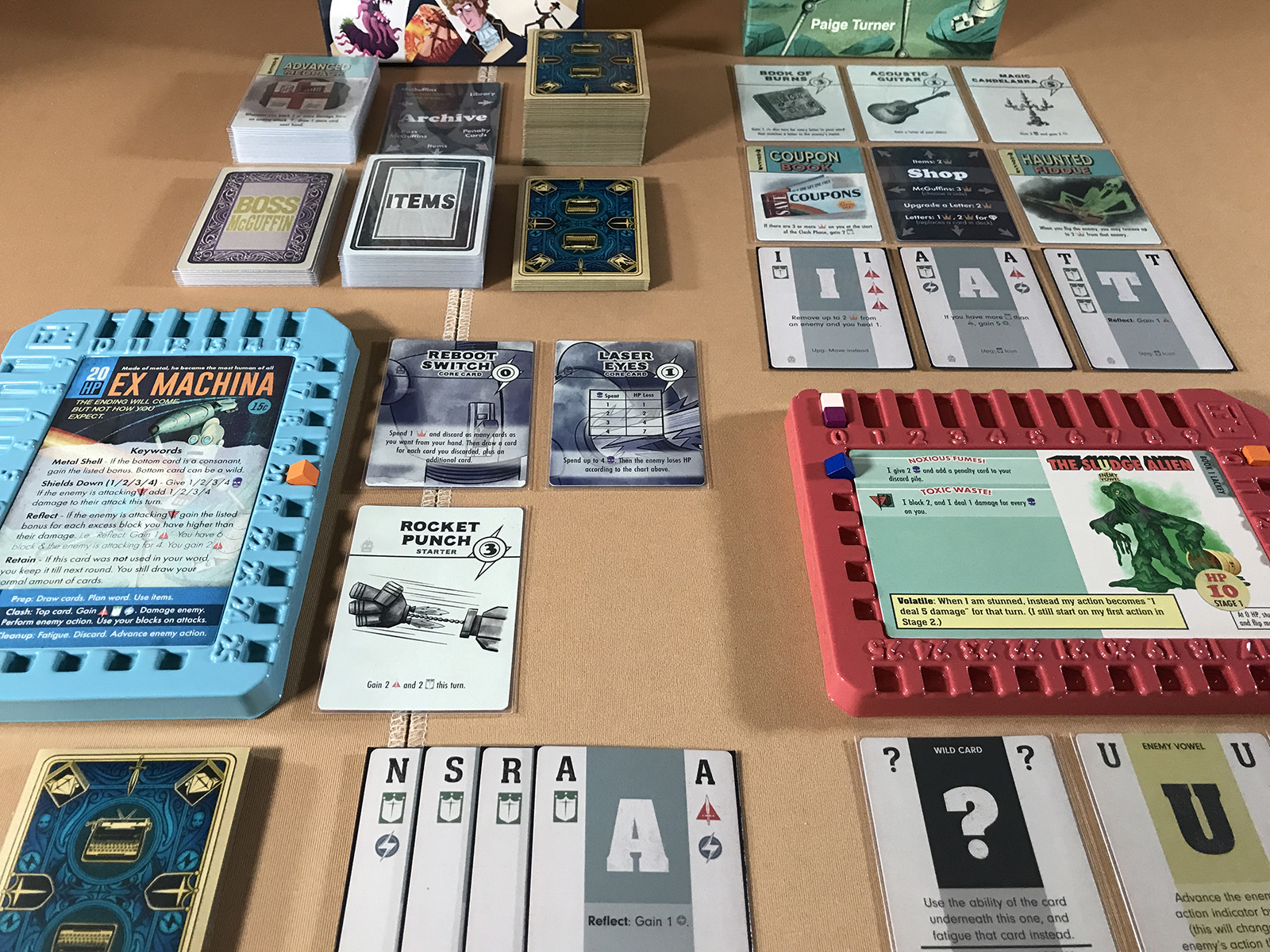
Plenty of Adventure
The size of the play area surprised me. So many cards! It was also apparently required to sleeve everything, so part of my setup was doing just that… And I don’t like sleeves.
Not to get too far ahead, but all of the cards and decks above the character trays offered so many options. Yet, so few of these cards were actually utilized.
See the giant stack near the top middle? I might add or swap out a few into my deck during the whole campaign.
I was a little skeptical about how this all was going to work, but I was still excited to start using my letters!
The Sludge Alien
The ultimate goal is to survive through 3 books, each of which features a lackey and boss. Up first was this rather sticky and gooey alien. Watch out for the puddles!
I’ll also take a moment to point out how lightweight these trays are. Various elements are tracked during a round, and I had to be careful about keeping this in place.
The nice metal markers look great, but require so much force to go into the spaces that I immediately used cubes.
With alternating actions, I had a good idea of what was coming up. Easy enough to plan ahead a little bit!

Making Words
As I mentioned before, words are the name of this game! With a hand that usually consists of 4 letter cards, each turn requires a word to be created and played.
The letter cards can be splayed left or right, which offer a few options. Symbols usually focus on defense or attack, and only the top card may be used for its special ability.
Yet a top card is exhausted after being used, which means it isn’t available for the rest of the battle.
I liked this system, although I was mostly limited to just 3-4 letter words, even with a wildcard available.

The Ending of Book 1
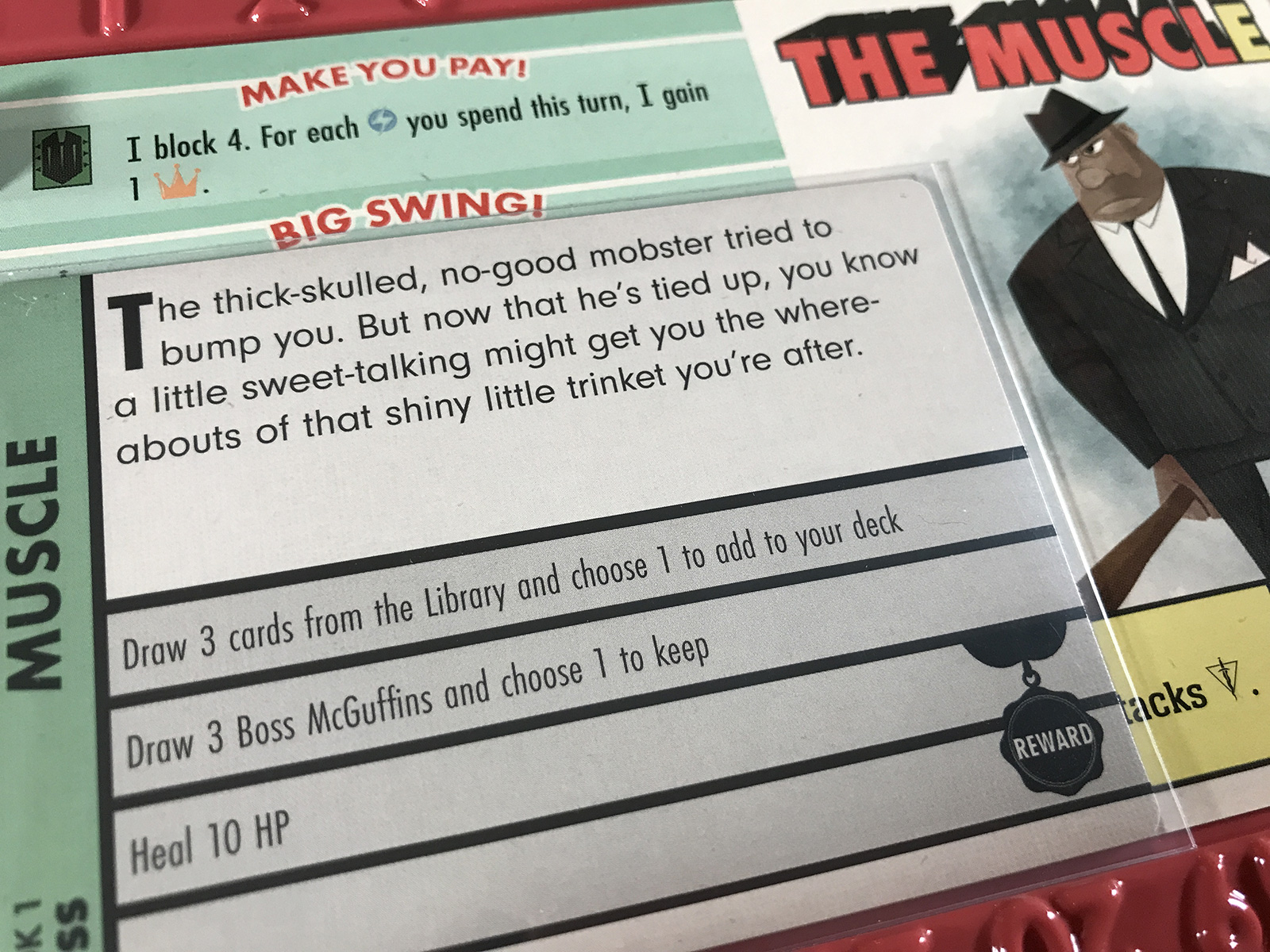
Most rounds progressed in the same way, so the lackey was easy enough to dispatch! Then, it was onward to the actual boss, who turned out to be the Muscle.
The new abilities made me think harder, and the different stages ensured the battle wasn’t over too quickly.
This double-sided card provided a set of different options, which cleverly came with a little story snippet. Nice!
But as I prepared to dig into the second book, I realized I had only seen a very small portion of the content. My deck was very close to what I had started out with, after all.
Variability: An Illusion or Actuality?
I’ve played lots of solo games with huge stacks of cards where only a small portion are used during each play. So I wanted to figure out why it felt so different here. These weren’t necessarily the largest stacks out there, but I figured it out pretty quickly. There was the illusion that there was a lot of possible variety with the cards I could add.
In actuality, there were only a couple of instances where I added anything to my play area. My deck of letter cards had 2 substitutions and a new card. I never had enough to purchase anything available in the shop. Was I just playing terribly?! Possibly. Yet I felt like all of the promised variability was out of reach, and I would only change up a few cards.
There were all sort sof cool cards I could see, but could simply never get! That was a little frustrating, especially since most of my draws were random. I didn’t have the chance to really piece together useful items and McGuffins. Letter cards were mostly replaced for better symbols, or possibly an interesting ability. That wasn’t enough for me, though.
I have no doubt that there are a lot of different cards so that each play might feature unique cards. Yet there was no guarantee that they would work together, so I could see myself struggling along time and time again. That didn’t scream of high variability to me, unfortunately. Like Ex Machina actually existing, this all felt like an illusion.
Clever as a Fox
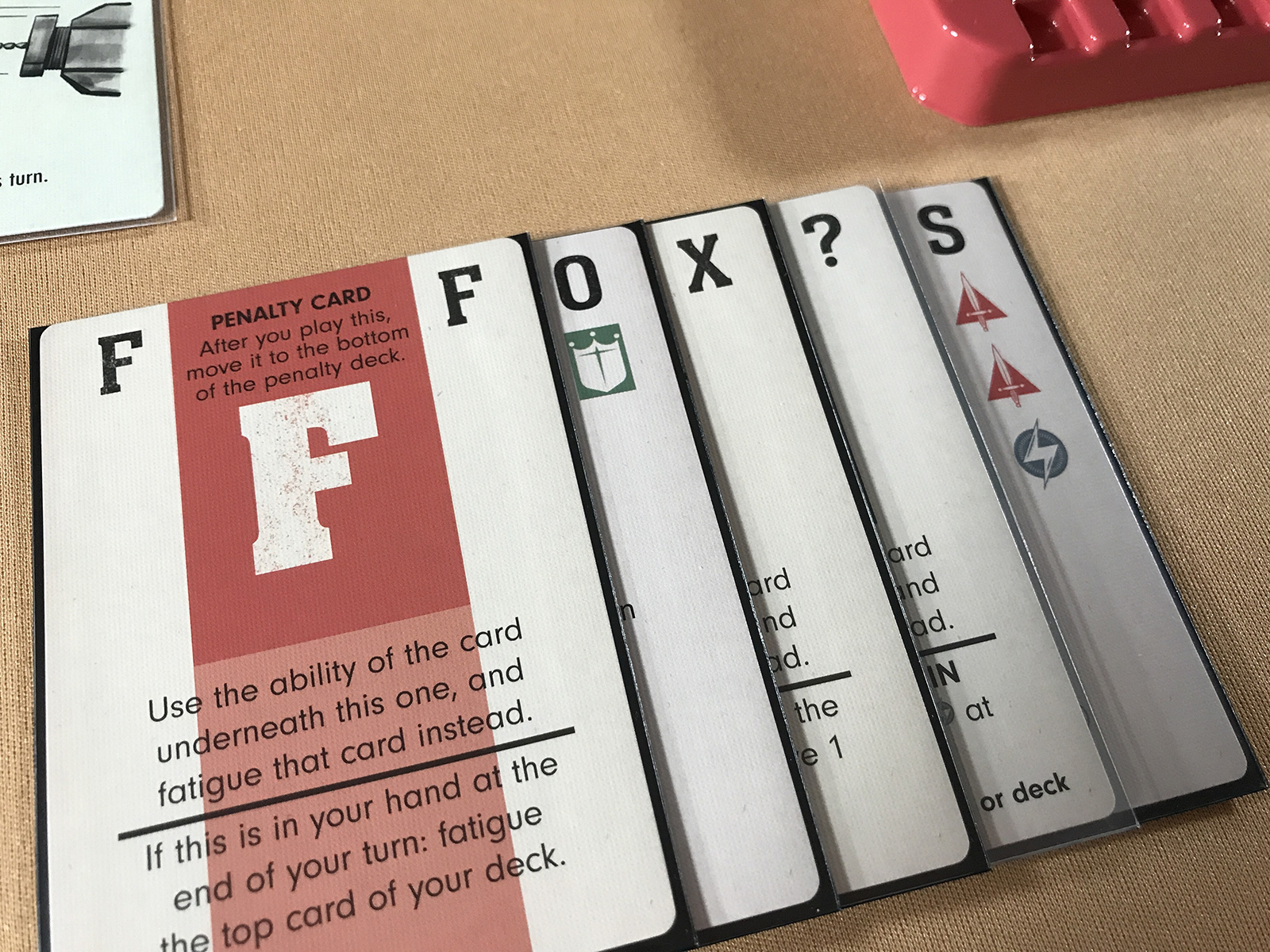
Some adversaries added penalty cards to my deck. These were more uncommon letters, and there were no bonus symbols to make use of. I picked up a bunch of these!
Ah, but when I drew my hand, I saw how I could form a word with the use of the wildcard. Foxes, it was!
However much fun I enjoyed making words, they weren’t all that different. My hand mostly consisted of the starting letter cards, so I sometimes went back to the same words.
I also didn’t find the choice of card splaying that compelling. I either attacked or defended each round.
Limited Shopping
As exciting as the shop seemed to be, I never had enough to actually purchase anything from it. Even then, I could really only see a maximum of 2-4 cards being added.
I loved the variety and humor in the items and McGuffins, yet they suffered from too much variability. The cards I drew, often face-down, didn’t synergize together.
This looked like a great way to upgrade my deck over the campaign, but there were so few opportunities to shop.
All of the concepts behind the game were amazing, yet as I continued on, it felt like the execution wasn’t quite there.

Dinosaur Trouble
The thematic mash-ups were also quite fun. Remember, I was playing as Ex Machina, a robot! So the diversity in lackeys and bosses was pretty comical.
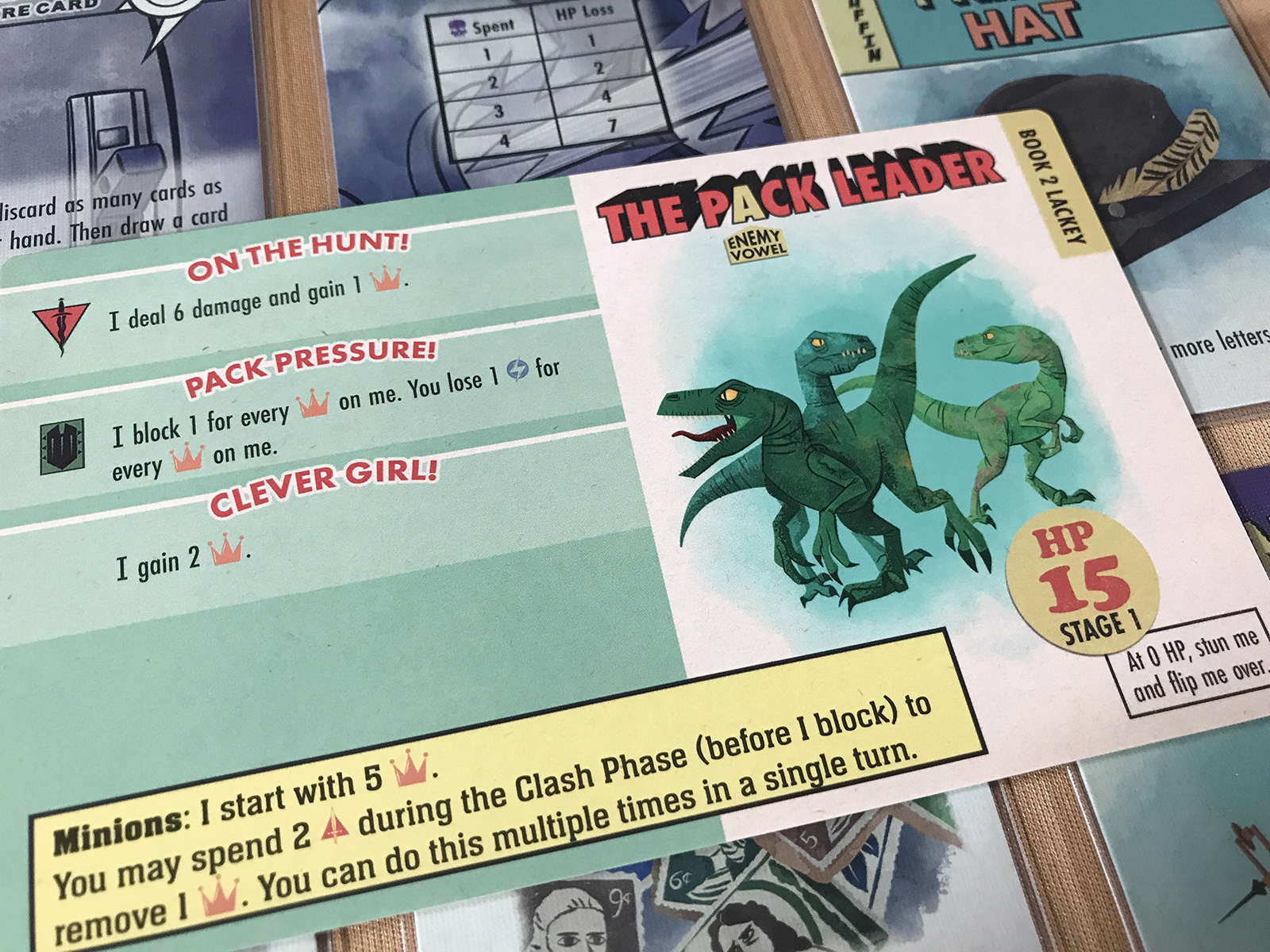
In book 2, I struggled mightily against some dinosaurs. With the enemy vowel card, I had some options in terms of skipping over the current enemy action. That was cool!
My items and McGuffins were all over the place, though. They weren’t super helpful to me, unfortunately.
Yet somehow, I survived this battle and was ready to move onto the book 2 boss. Who could it be?!
Session Overview
Play Number: 1-4
Expansion: Paperback Adventures: Ex Machina
Solo Mode: Designed for Solo (Included in the Base Game)
Play Details: Books 1 and 2
Outcome: 3 Wins and 1 Loss
Well, it was the lone boss with an unpronouncable name who defeated me! This was very tough without the enemy vowel, for I had to simply handle the sequence of actions. And so ended the exciting adventure of Ex Machina. As much as I appreciate a lot of the elements here, I don’t believe I’ll be returning to craft a sequel to this session.

%
1 Play
Affordability
Price & Value
4
Functionality
Challenges & Mechanics
7
Originality
Design & Theme
7
Quality
Components & Rules
4
Reusability
Achievement & Enjoyment
6
Variability
Distinctness & Randomness
5
+ Pros (Positives)
- Battling adversaries with words throughout a book series is an excellent idea, and comes through with the rules.
- Items and McGuffins offer very unique abilities, yet often bring some laughs when they’re incorporated.
- Completing a book offers different possible rewards and the decision is an important one for moving forward.
- A mini-campaign across the trilogy offers an ongoing storyline and challenge to keep the protagonist alive.
- Words usually aren’t too difficult to form, especially with the wildcard option to fill in a letter of choice.
- There is a very vintage paperback feel to the artwork, which helps bring the ongoing story to life even more.
– Cons (Negatives)
- The trays are too light for regular use, and the metal trackers are too tight to constantly move around the slots.
- Despite the large number of cards, a campaign only offers a few opportunities to add or replace letter cards.
- Not every rule is clearly laid out, and it can be a little confusing to figure out how to handle edge cases.
- For the play time, setup is a bit much and played words can get repetitive with the same deck during a campaign.
Victory Conditions
Defeat the Lackey or Boss
- Overall Goal Progress 67%
Goals and Milestones
Complete book 1 as Ex Machina.
Complete book 1 as Plothook.
Complete book 2 as Ex Machina.
Continue the Conversation
What are your thoughts about Paperback Adventures? Do you have a favorite protagonist, lackey, or boss? I was hoping to enjoy this one more than I did, yet it has some very nice concepts! There were some enjoyable moments of forming words out of letters I didn’t think would work. Ex Machina’s time may have run out, but I’m onto more solo games!
This is a series of games that haven’t thrilled you and even did not grab you at all… Give yourself a break, play a game of Obsession!
Ha! Definitely need to do that soon. I will say that the game I played right after this one, and that’s been on my table for a week, is a wonderful one that I’m simply loving. Nice to have found it in this mix, and I’ve got lots of great things to write about it!