Tiwanaku: An Abstract Game That Doesn’t Re-Invent the Wheel

Discover what lies in an unexplored valley and deduce the arrangement of various crops with a unique wheel in Tiwanaku.
Using deduction to solve puzzles is something I’ve always enjoyed, although I often equate it to systems I know or the general mystery genre. In Tiwanaku, it’s all about exploring terrain and using the spatial puzzle to figure out the desired arrangement of crops. So very unique! I eagerly jumped into the rules and was excited to start puzzling away!
Game Overview
Game Name: Tiwanaku
Publication Year: 2023
Designer: Olivier Grégoire
Artist: Raphaël Samakh
Publisher: Sit Down!
Solo Mode: Included in the Base Game
From a mostly empty map, terrain and crops are slowly placed and revealed. Placement restrictions help inform some deductions, which are checked against a clever wheel with coordinates. Diversity in terrain tiles is important, as is gaining more victory points than Otoma!

First Play
March 23, 2023
Complexity
2
Latest Play
August 12, 2024
Expansions
1
Setup Time
10 Minutes
Lifetime Plays
4
Play Time
40 Minutes
High Score
119
Game Area
24" x 24"
Low Score
77
Adorable Alpacas
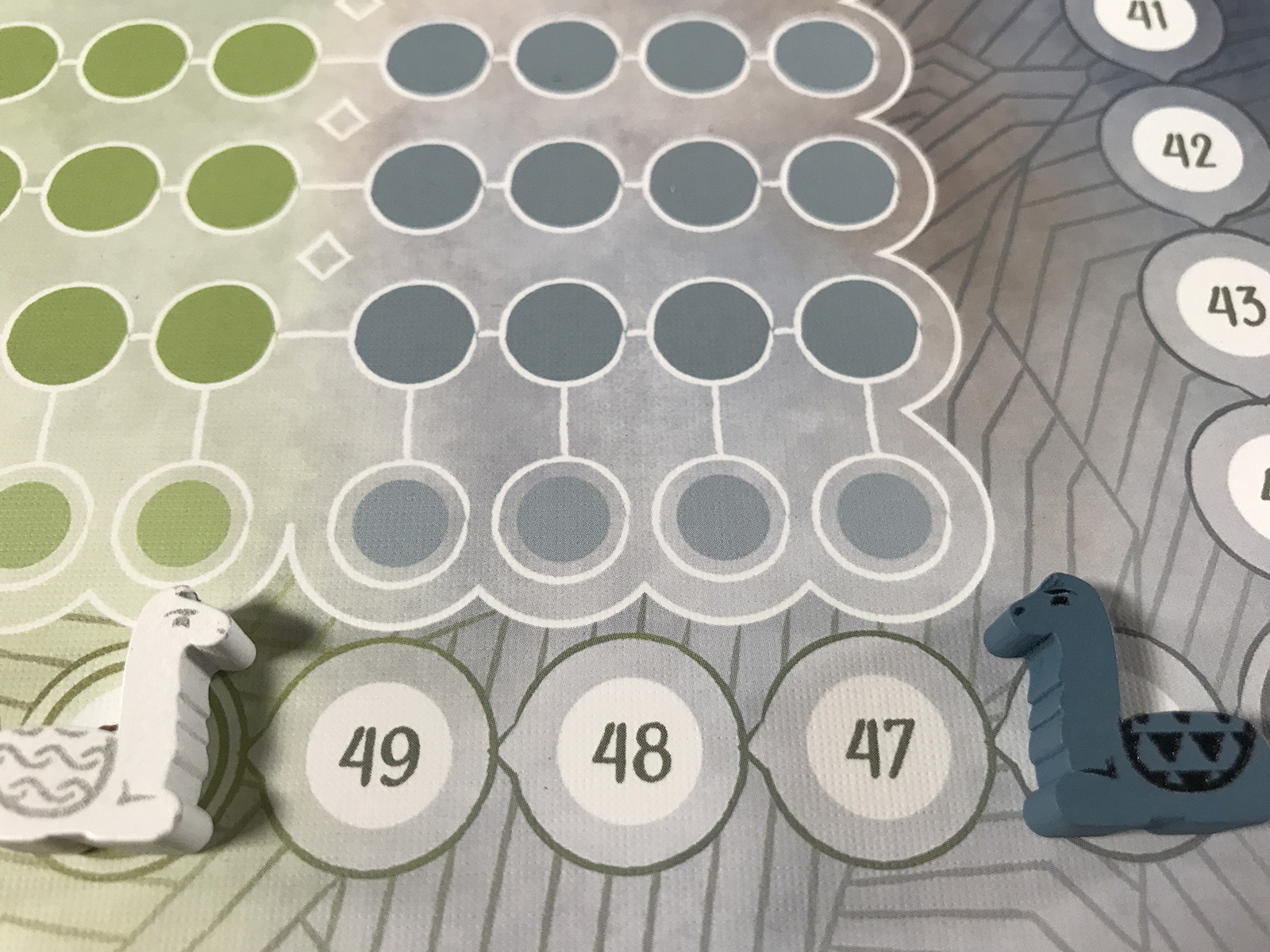
It was too hard to resist bringing in my Calico Critters alapacas when I spotted the scoring markers and screens!
Maybe they didn’t feature the properly long necks, yet this pair was all set and ready to dig into deduction.
The theme seemed interesting, playing as the Quechua people of South America to explore a new valley and trying to figure out the clues from the goddess, Pachamama.
Terrain is uncovered, and crops must be determined based on specific rules. All in all, though, this was an easy system to get into without too much to remember.

A Useful Rulebook
There were only a few pages of rules to understand, and it all ended with an interactive example at the very end!
I thought this was a clever way to teach the concepts. In a nutshell, terrain tiles are only ever in groups of 1-5. Groups of the same type will never touch, even diagonally.
Similarly, crops are based on the size of the terrain group but will never touch on any side, including diagonally. In a size 5 group, each crop will show up just once.
Smaller groups include fewer crops. For example, a size 2 group will only feature crops 1 and 2, and never any more.

Wheel of Deduction
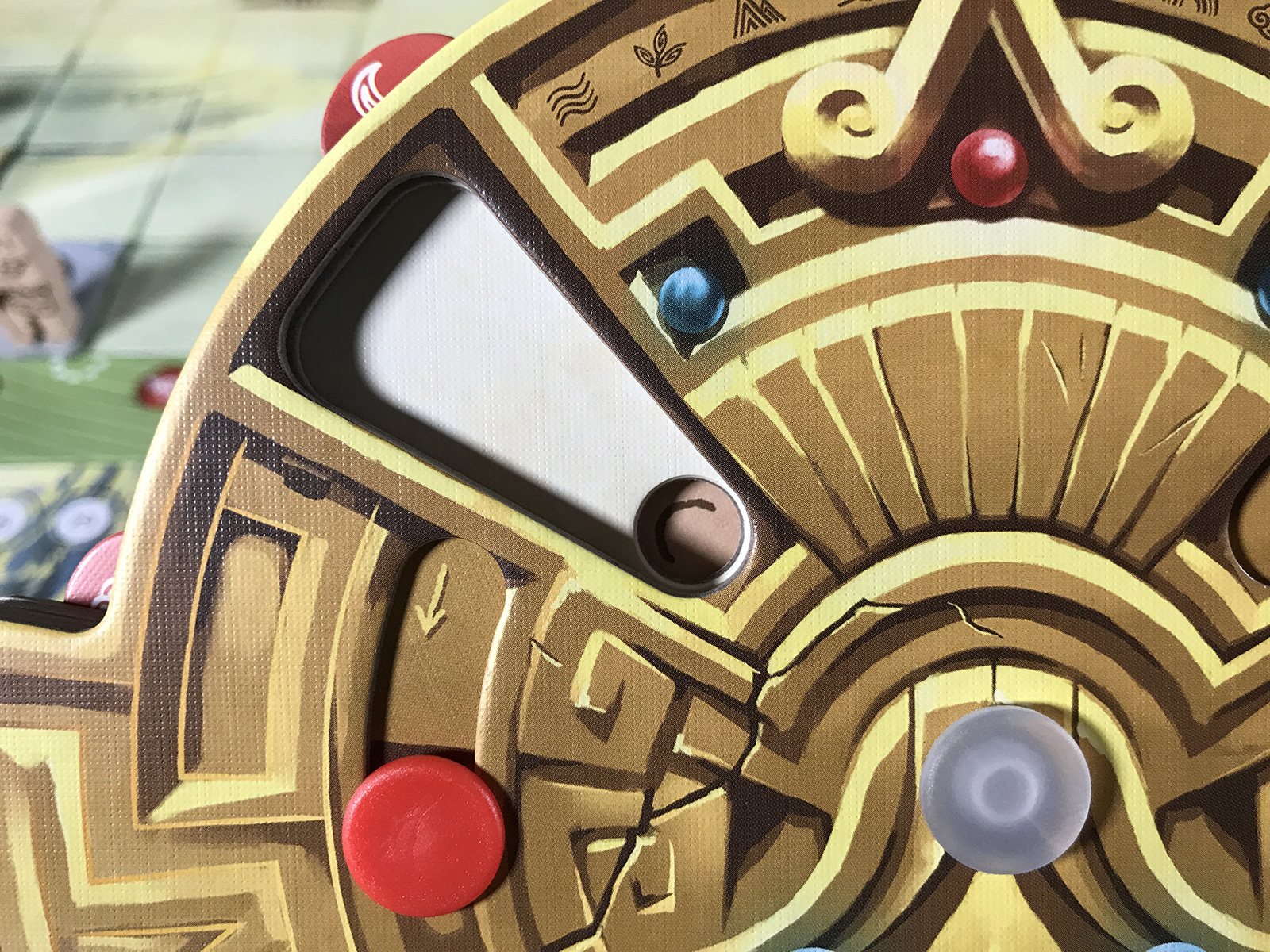
So where does deduction come in on this grid? From a pretty awesome component! This wheel features many layers of cardboard designed to provide answers.
During setup, a scenario disc is inserted. This does involve removing and resetting the central axis, although this has been very easy to do with no signs of wear.
The map features a grid, so this is all about plugging in the coordinates of the row and column a farmer is in.
A pair of windows may slide open with the red discs to reveal either the correct terrain or crop type. Very neat!

Diverse Terrain
In a lot of solo deduction games, I’ve found that it feels like more of an activity. I work towards finding the solution, and I either get it right or wrong. That’s all!
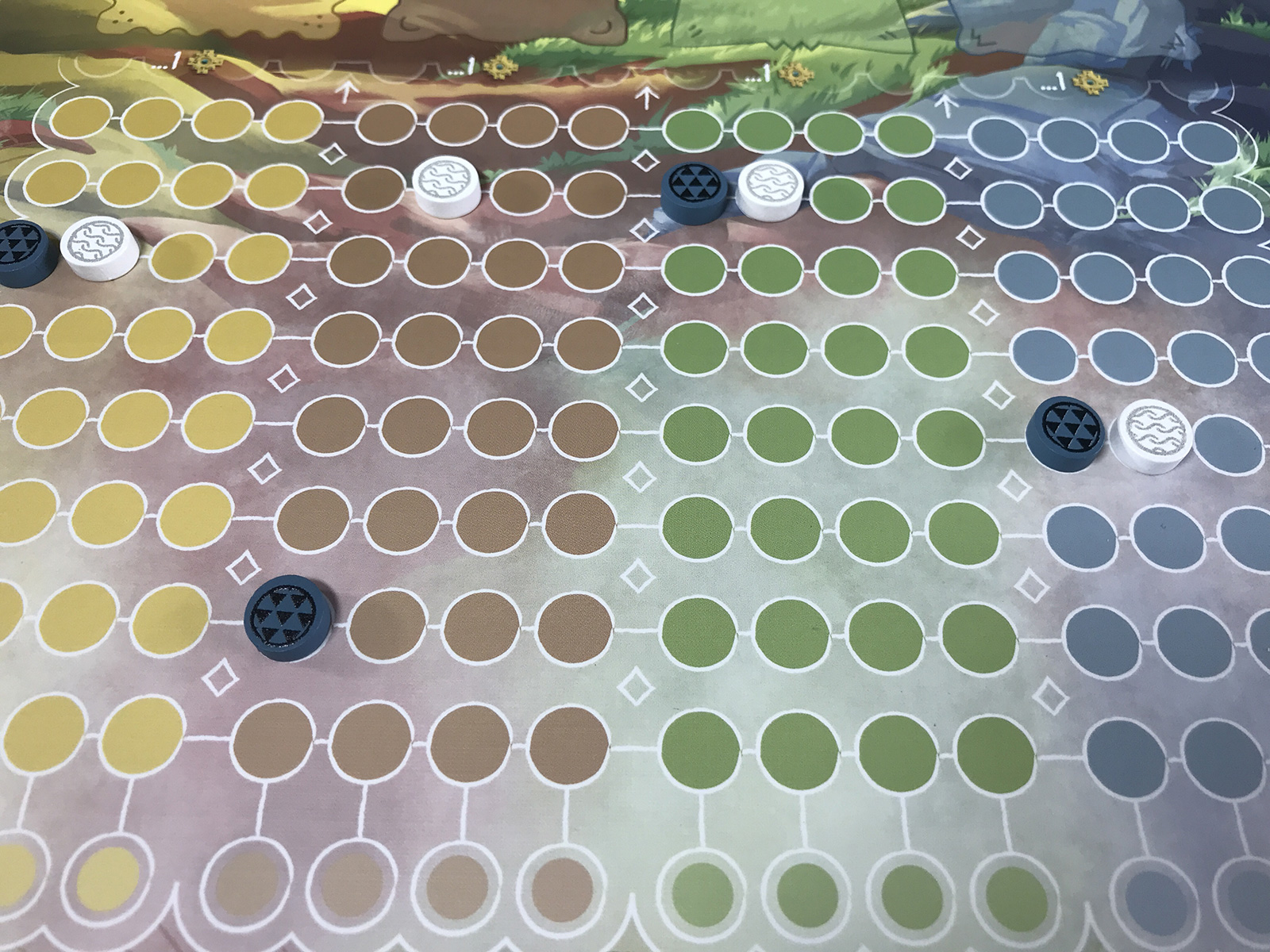
Here, there are some more actual game elements, like a scoring track. Victory points come from deducing the correct crops, but also from terrain diversity.
When a new terrain tile is discovered, a marker goes up on the matching track. The trick is to increase them together.
Between 1 and 4 victory points are earned for all of the markers at the new level. Diversifying definitely helps!

A Scenario Beginning
According to the scenario disc, setup involves placing a few terrain tiles and crop types. The solo opponent, or Otoma, then begins with 5 explorers on the map.
From this limited information, it’s basically impossible to know anything from the start. However, I do know the bottom left tile can’t have a level 1 or level 2 crop.
That means that either the mountain or soil group must be at least 3 tiles large in order for it all to make sense.
I loved the example deduction puzzle, and couldn’t wait to actually get started with using the wheel here!

Round and Round!
Alright. This wheel might be one of my favorite new components I’ve seen lately! Simply by inputting the symbols of the row and column, I had the answers.
Opening up the window was also fun, especially since I waited until I knew for sure what I would be guessing in terms of crops. Maybe that was a little too careful!
Constantly rotating it for my turn and the solo opponent’s turn didn’t feel cumbersome, either. But I love wheels!
One window tended to partially open a little bit when I handled this exactly upright, but otherwise, perfection!
In Appreciation of New Components & Designs
When I decided to back this game, I thought the wheel might be a little too much of a gimmick to work well. But I was willing to give it a chance since I love puzzles and mysteries! I’m very glad I did: This isn’t something that was tossed together haphazardly, but a component that feels like a central element of gameplay. It is absolutely wonderful!
Maybe the idea behind the abstract puzzle isn’t entirely novel, as it’s often compared to a mixture between Minesweeper and Sudoku. But as I’ve mentioned recently, an excellent game doesn’t need to do anything brand new… Nor does it need to re-invent the wheel. Just USE the wheel. Ha ha! I really had an amazing time puzzling onward.
Alpaca Staredown
Not surpsrisingly, I wasn’t doing particularly well. Guessing incorrectly resulted in lost victory points, so I took things as slowly as I could. Still, not too shabby!
The solo opponent picked up victory points pretty much every time I explored, though, as a meeple moved to a new area to discover the terrain and crop type.
I was in need of a better way to pull ahead… The alpacas decided a silent staring contest might just be it!
Alas, these farmers and explorers can’t be intimidated, even by gigantic alpacas of the cute variety. Ha ha!

Narrow Loss
Oh, how the Otoma beat me by just a few victory points! I made a couple of rules mistakes along the way due to me getting way too excited with the wheel. No worries.
Maintaining diversity in the explored terrain was worth a lot of victory points, but also meant I had to plan ahead.
There wasn’t anything to guess when uncovering a terrain tile, but I had to try to choose places where I could maintain diversity on these different tracks. Challenging!
I definitely felt like this was more of a game than an activity, especially with the way I had to strategize.
A Finished Play Area
What a colorful final board! I really enjoyed how all of the information was easy to see at a glance, both with colors and symbols. Even the tiles had different edge shapes!
I had an exciting turn when all of my farmers discovered the correct crop types on their tiles. Deduction expert!
Not really, but I still had a lot of fun figuring out what I might find. Finding different crops can also lead to extra victory points with additional collected tokens to trade in.
Although gameplay was entirely abstract and didn’t feel thematic, I had a great time using the wheel to deduce!
Leaving Open Tiles
Now, part of my loss came from leaving terrain tiles without crops. If I returned, the arrow triggered the movement of the Otoma, giving away victory points.
The end game occurred when every terrain tile was placed, so I probably should have tried to guess these crops.
Again, this felt a lot more like I had to think things through. It wasn’t just about getting the right or wrong solution for every tile: Sometimes, wrong helped me out!
For instance, I might try to guess a crop type simply to uncover it for better adjacent deductions. Clever, clever.

Session Overview
Play Number: 1 and 2
Solo Mode: Included in the Base Game
Play Details: Scenario 1 and Scenario 2
Outcome: 106-110 and 77-100 (2 Losses)
Different scenario discs help avoid memorizing any solutions, so I played back-to-back. No luck for me this time, although I enjoyed the challenge immensely! I knew what I did to lose victory points, so there’s a chance to do better in the future. Play time was a little lengthy, yet it honestly felt like maybe 15-20 minutes. This is a lovely deduction game I look forward to winning someday!
%
1 Play
Affordability
Price & Value
9
Functionality
Challenges & Mechanics
10
Originality
Design & Theme
8
Quality
Components & Rules
9
Reusability
Achievement & Enjoyment
7
Variability
Distinctness & Randomness
4
+ Pros (Positives)
- The wheel functions very well, and even loading or unloading a scenario disc is quick with no problems.
- All of the iconography is easy to see, both in terms of colors and shapes, across all of the components.
- Scenario discs help randomize the puzzle so it’s very difficult to ever memorize terrain and crop locations.
- Victory points and different ways to advance ensure that there is more going on than a right or wrong answer.
- Despite the theme not coming through, it’s a unique idea backed up by beautiful visuals to admire.
- It’s pretty easy to grasp the rules and simple action choices, but making correct deductions takes some skill.
– Cons (Negatives)
- As with other puzzle games of this sort, there isn’t a lot of variety and it may not feel as novel over time.
- More scenarios are available, but the insert does not include any room for extra scenario discs, unfortunately.
- The solo opponent is activated randomly with new terrain tiles, which can lead to unwanted exploration at times.
- With so much going on with the diversity board, it can be a little too easy to knock over the scoring markers.
Victory Conditions
Score the Most Points
- Overall Goal Progress 100%
Goals and Milestones
Score at least 100 points.
Score at least 110 points.
Win at least 1 game at the easy difficulty level.
Continue the Conversation
Have you had a chance to try out Tiwanaku? Do you enjoy other solo deduction games? It was a pleasant surprise to see that this leaned more heavily into a game than an activity. There were enough moving parts to keep me interested and thinking, yet it was just the right level of difficulty. I’m excited to see a wheel used with this, too: Such a neat design!
0 Comments