Debts vs. Deeds with Viscounts of the West Kingdom

Travel around the land to write manuscripts, construct buildings, and recruit new allies in Viscounts of the West Kingdom.
My journey into the west has been an interesting and rather unusual one, skipping around quite a lot! Yet it was time to get Viscounts of the West Kingdom to my table to try out the solo mode. Such a table presence! I was immediately excited about the gigantic castle in the middle and all of the different options. Yet how would it all play out?
Game Overview
Game Name: Viscounts of the West Kingdom
Publication Year: 2020
Designers: Shem Phillips and S J Macdonald
Artist: Mihajlo Dimitrievski
Publisher: Garphill Games
Solo Mode: Included in the Base Game
Many available actions, like adding presence to the castle or writing a manuscript, take a lot of careful planning. The position of a viscount plays a major role, as does the available allies that slowly pass through the player mat. So many decisions, all in a beautiful and imposing space!

First Play
May 6, 2022
Complexity
3
Latest Play
November 28, 2025
Expansions
3
Setup Time
15 Minutes
Lifetime Plays
4
Play Time
1 Hour
High Score
93
Game Area
40" x 30"
Low Score
45
Many Considerations
I was prepared for a lot of elements, yet that almost felt like an understatement! My player mat had buildings with bonuses to think about once they were built.
Corruption and virtue shared the same track, yet timing when these trackers collided was going to be strategic!
My neat rows of workers were all set and ready to climb into the castle, which came with its own set of benefits.
And last, but not least, were my townsfolk… Cards with symbols and special abilities to use at just the right times. “A lot” definitely seemed like too little to describe it all!

A Trusty Companion
The component quality was absolutely amazing, right down to the enormous wooden viscounts atop prancing ponies. But there was something missing from the game…
Enter an adorable Calico Critter! She was determined to accompany my viscount across the open lands. So cute!
It was a land devoid of dangers, yet the corruption and even criminal townsfolk offered up some thoughtful choices. What to do? Just keep a tiny dog with you!
Reasonably comfortable with the rules and iconography, I eagerly began my play of this previously unopened game.
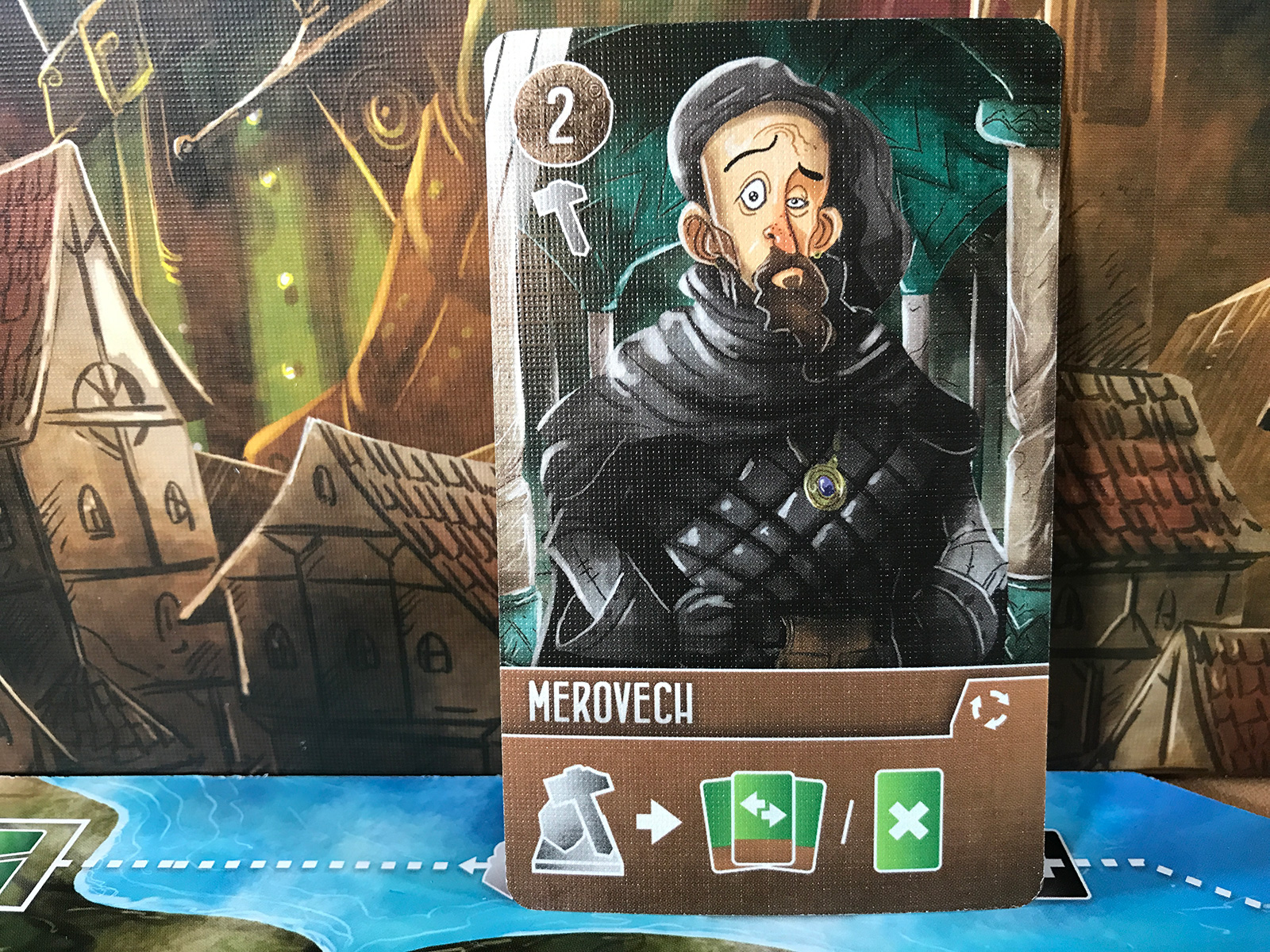
Merovech the Builder
During setup, I assumed some of the special townsfolk would act as heroes to pick up. Not quite: They provided a set of unique individuals for a slightly different start.
Paired with a resource card that seemed to be on the right track, I welcomed Merovech into the group.
Note that this is a game that heavily relies on icons, but many of them become intuitive pretty quickly. Plus, there is a reference guide on the back of the rulebook. Nice!
Essentially, every time I took a build action, I could either reorder my townsfolk or discard a card. Useful, indeed.
Round and Round
Part of me wondered if the castle was going to feel like an overproduced component that didn’t do much. Not so!
It neatly snapped around the map pieces to keep them safely secured while I had my viscount’s pony racing around. Missed opportunity for fantastic sound effects.
However, it also provided nice areas to keep the worker meeples secured. They fit without flying all over the place.
After all, this could serve as a main scoring region. Only it took some careful planning to climb up the different levels with the way everyone cascaded around… Very tricky!

A Clever Opponent
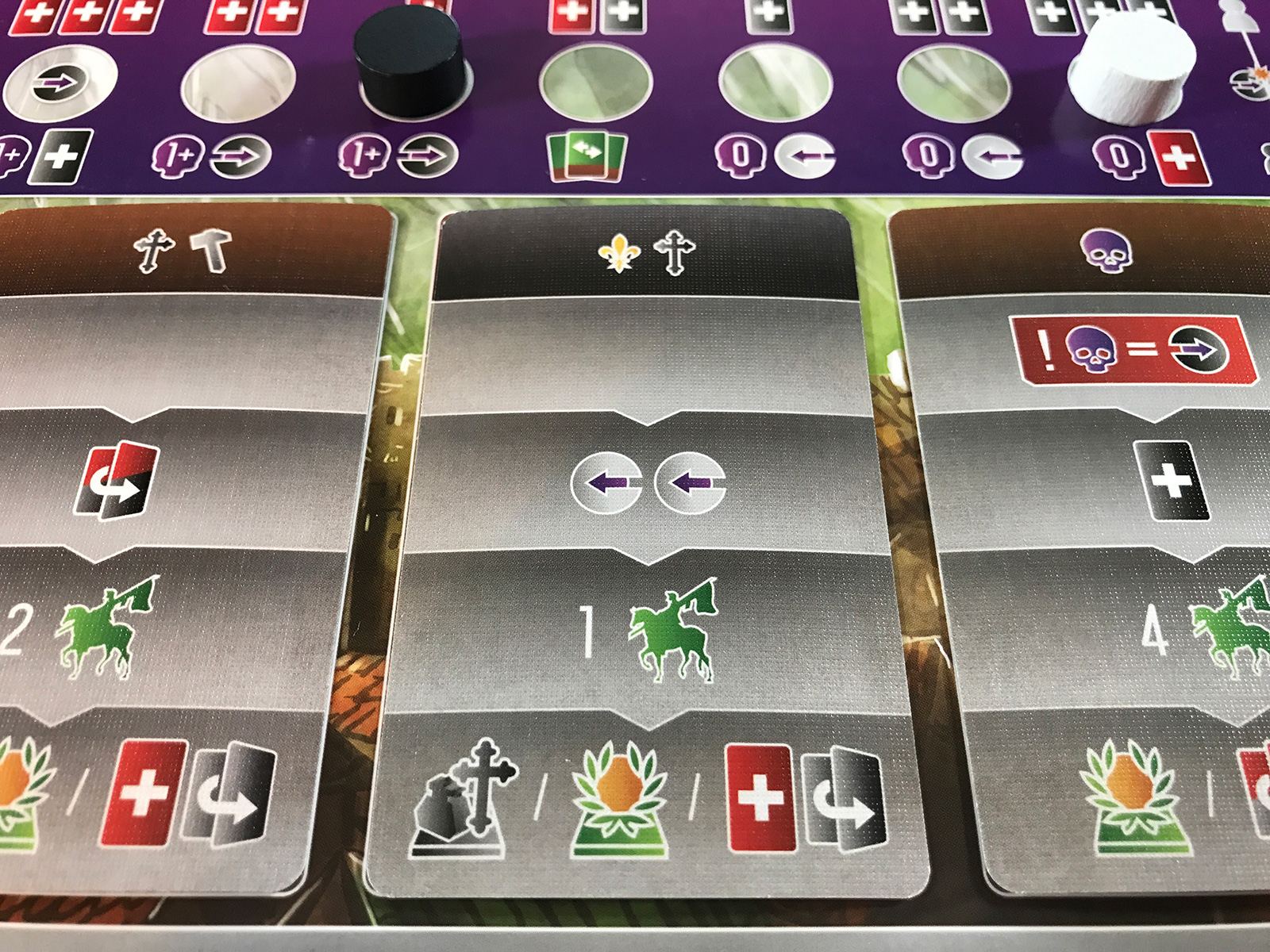
There are many things to keep in mind when managing the solo opponent, although it mostly comes down to knowing what the various icons do.
I struggled with a couple of instances, yet figured it out pretty quickly! Everything didn’t feel as intuitive as I might have expected… I’ve seen much worse, though.
Corruption and virtue played a role here, but I watched it carefully to see if I might benefit from each collision.
One element I enjoyed was how each solo opponent had its own focus, thereby providing a different challenge.
Townsfolk Help
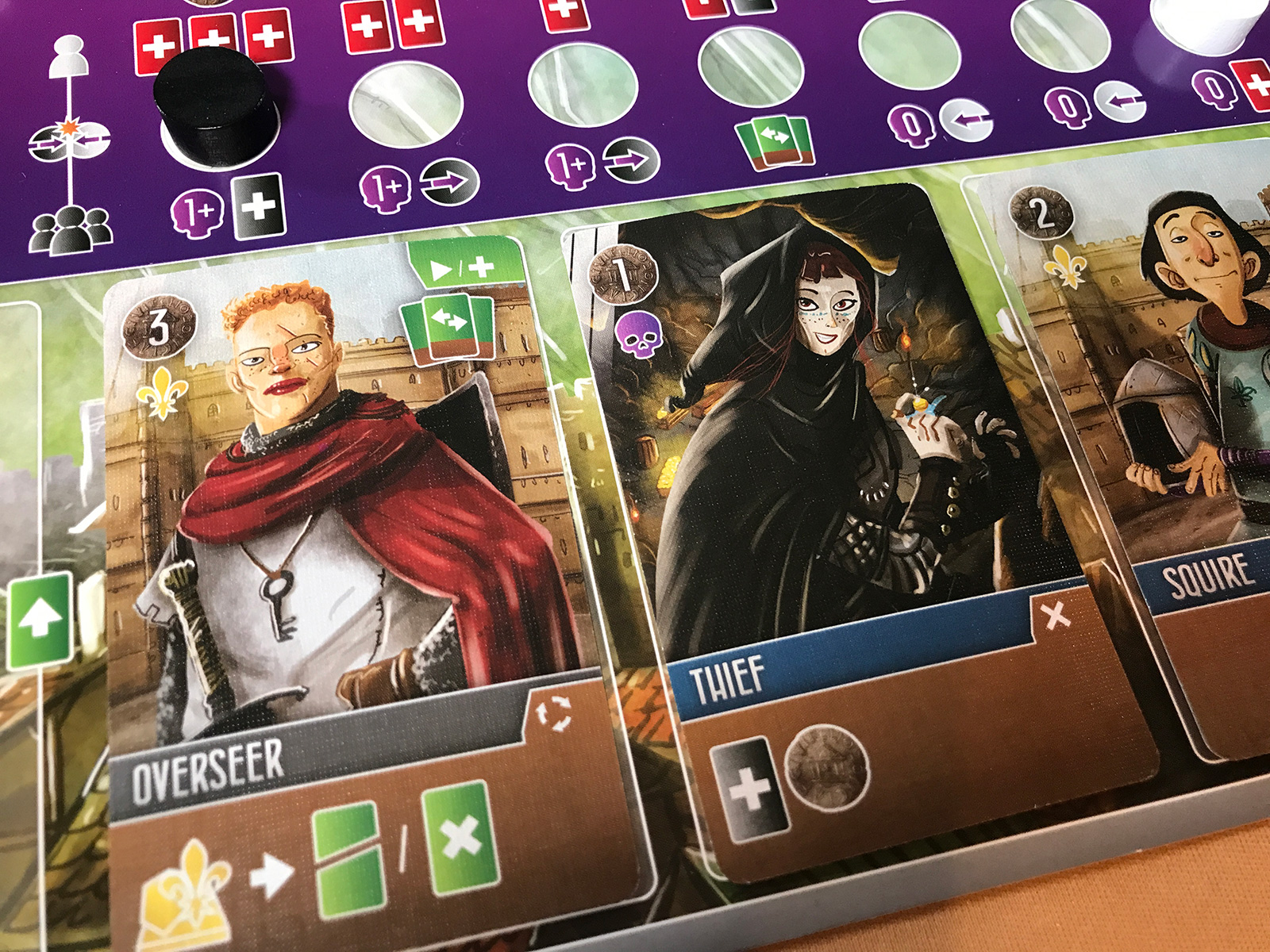
Even with so many elements in motion, the central part of gameplay came down to the townsfolk cards. The starting hand provided basic benefits and some icons.
Over time, I recruited new townsfolk and watched as this line slowly cycled through. A diverse deck was helpful, but specializing in a couple of actions helped out a lot.
I had to watch out for the criminals, although I liked how their symbols were wild for better icon-stacking.
My downfall was completely misunderstanding the end game condition for deeds and debts… I had it backwards!
The Push-and-Pull of Poverty and Prosperity
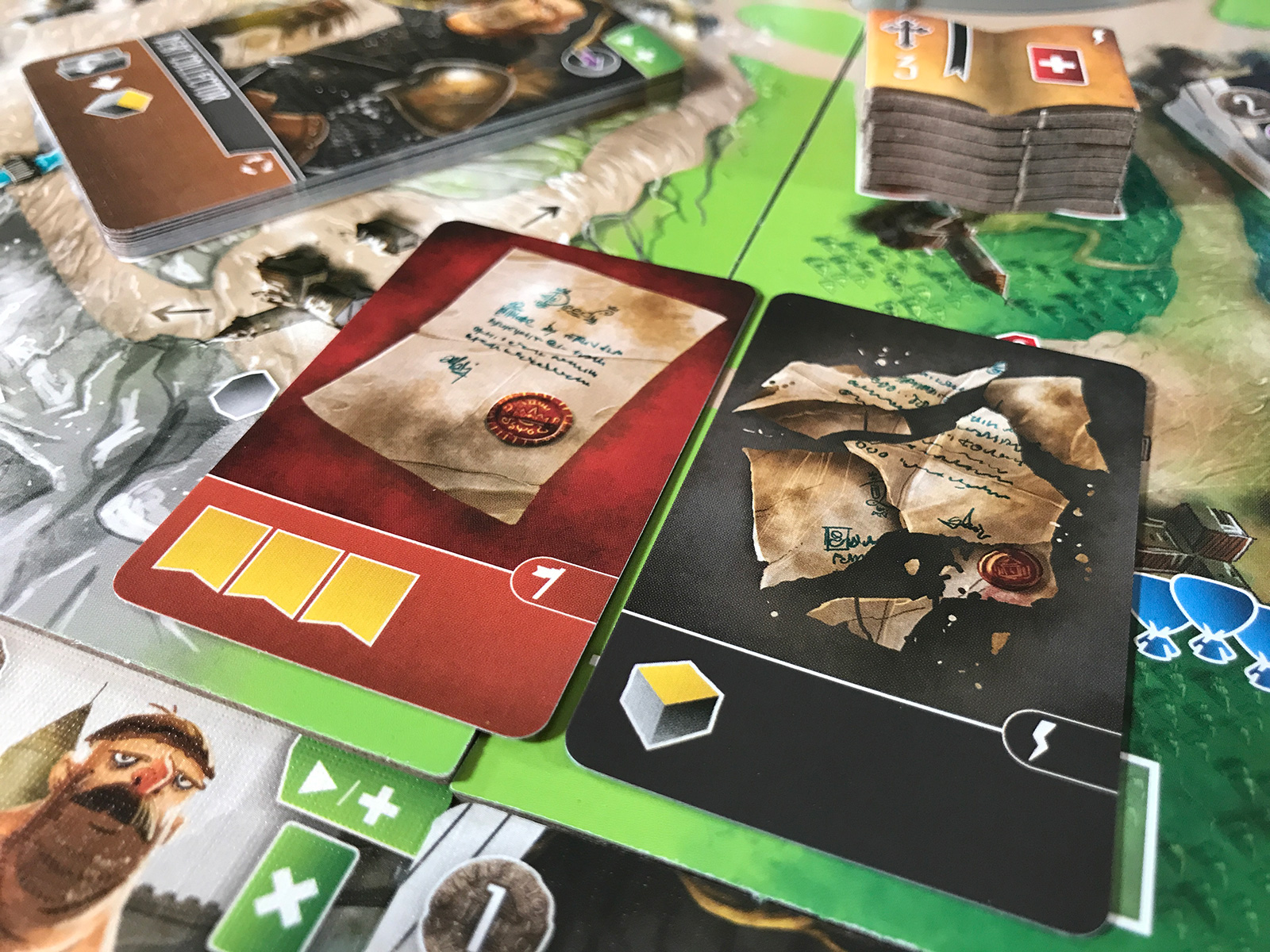
I only had myself to blame for not seeing how things worked! In a classic misinterpretation, I thought that emptying the debts scored majority points for total flipped debts… But it was actually deeds. The icons were right there, yet after I realized my mistake, it made sense why I didn’t feel like there was a major tug-of-war between these elements.
Looking back, that likely would have improved gameplay a lot more! I still enjoyed all of the decisions, yet perhaps I might have had a chance at winning if I understood more about how emptying the piles worked for end game scoring. This is why I still rate a game after a few plays, but usually don’t take my rating seriously until about 10 plays.
So much learning! This is an aspect of solo play that isn’t always obvious, yet there isn’t anyone else around to quickly point out rules mistakes. Interpretations of the sequences and limitations are left entirely up to the solo player. We might make a bundle of mistakes, yet at least for me, I end up understanding the rules very well after a couple of plays.
Claiming the Castle
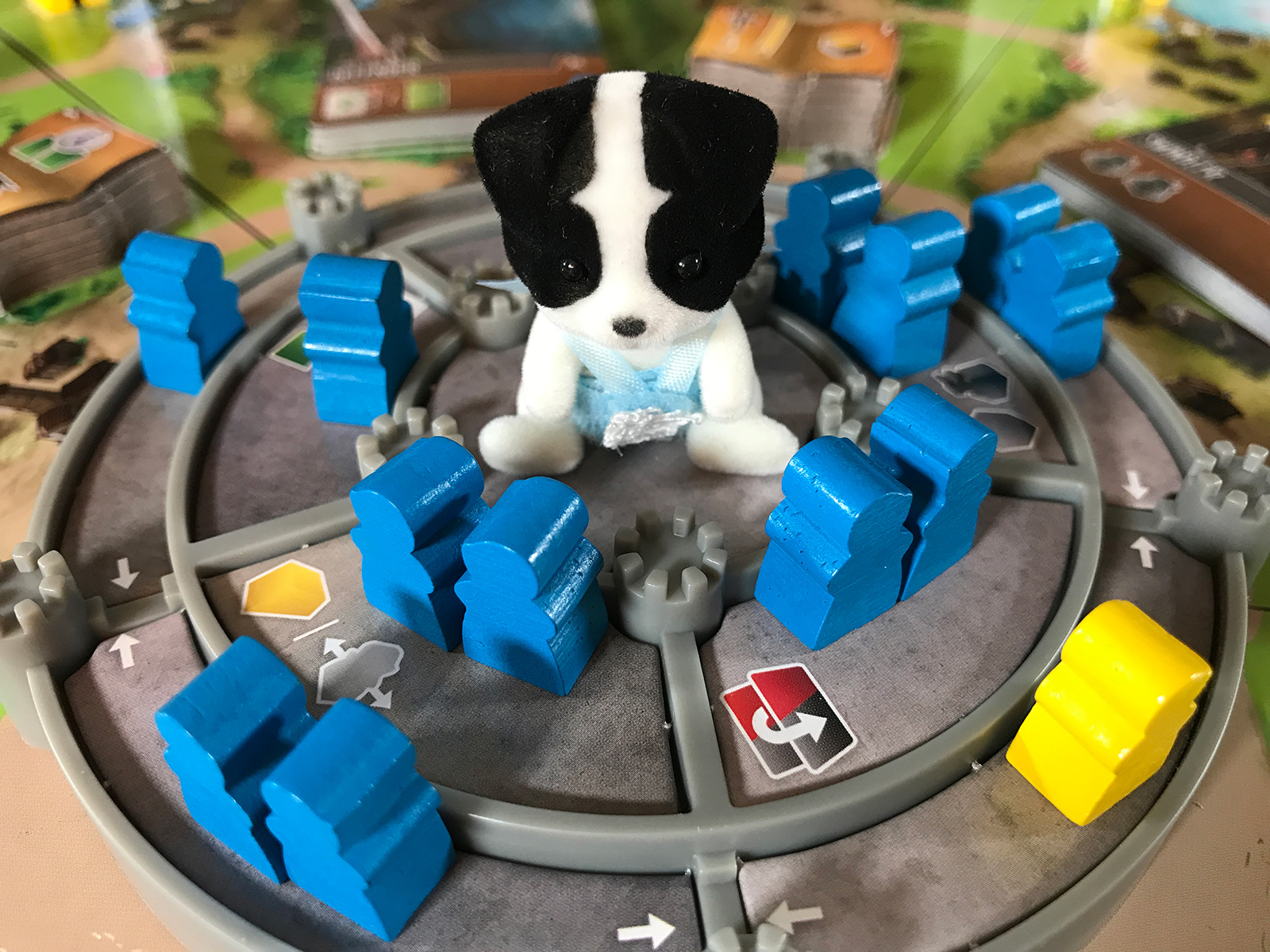
It took many turns for me to start getting into the groove of gameplay, but I noticed that the solo opponent rarely put anyone in the castle. It was all mine!
Actually, a certain Calico Critter decided that the top tier, which remained empty, would be his tiny throne. Ha!
I likely wasted a few turns trying to add more buildings or write manuscripts when I would have done well to climb up through the castle quicker. It was still very close.
The cascading sort of effect was quite neat, as were the bonuses for moving up. Definitely a viable strategy!
Debts and Deeds
A small part of me felt like the game end was a bit of a letdown, mainly since it all came down to emptying out a pile of debt or deed cards. Not all that exciting.
It felt like I did a lot of work only to arbitrarily empty a pile of cards. Now, to be fair, my backwards interpretation of scoring probably played into that! Add 1 error to myself.
However, there was a lot going on. I felt like there were a touch too many decisions for the excitement of scoring.
Even with the correct understanding of debts and deeds, though, I saw a possibly over-complicated set of actions.
Session Overview
Play Number: 1 and 2
Solo Mode: Included in the Base Game
Play Details: Builder Solo Opponent
Outcome: 55-59 and 49-62 (2 Losses)
I was delighted with all of the different townsfolk! The various synergies were extremely helpful, and even rather thematic. This trio helped me out quite a lot! I still fell short in both plays, likely hampered by my focus on collecting deeds over debt. Lots to adjust the next time I play! A lot of elements felt a bit over-the-top, yet this was still a very solid solo game with meaningful choices.

%
1 Play
Affordability
Price & Value
9
Functionality
Challenges & Mechanics
9
Originality
Design & Theme
8
Quality
Components & Rules
9
Reusability
Achievement & Enjoyment
7
Variability
Distinctness & Randomness
9
+ Pros (Positives)
- The component quality is excellent, from the townsfolk cards to the tiered castle that holds all of the map pieces.
- Finding synergies between the cards is a lot of fun and can help lead to a focus on certain actions to move ahead.
- Interplay between debts and deeds, as well as corruption and virtue, adds an interesting layer of gameplay.
- Multiple solo opponents create different action focuses, which can create very different solo play experiences.
- Setup involves a number of randomized elements to add gameplay variety without a lot of extra effort.
- Certain turns may lead to a lot of careful planning, yet play time moves pretty quickly without much upkeep.
– Cons (Negatives)
- There are a lot of icons to learn, and despite the guide, remembering the solo opponent’s rules are difficult.
- With so many possible actions every turn, it can be easy to lose track of something or get lost in the choices.
- The game end condition of emptying a deck of cards can feel a bit disconnected from the rest of gameplay.
- It isn’t always clear what sort of strategy is the best to take with the way the solo opponent can act too randomly.
Victory Conditions
Score the Most Points
- Overall Goal Progress 67%
Goals and Milestones
Win at least 1 game against the card solo opponent.
Win at least 1 game at the standard difficulty level.
Win at least 1 game against the builder solo opponent.
Continue the Conversation
What do you think of Viscounts of the West Kingdom? I’m still at an odd crossroads with this series, having missed out on arguably the best solo experience so far… Making progress, though! Are there any other related series like this you enjoy? I have a few things to correct the next time I play, yet overall, this was a lot of fun with quality components!
0 Comments